
Do Employers Actually Care About Your Dissertation? Answered by a Dissertation Expert With 12 Years of Research Guidance
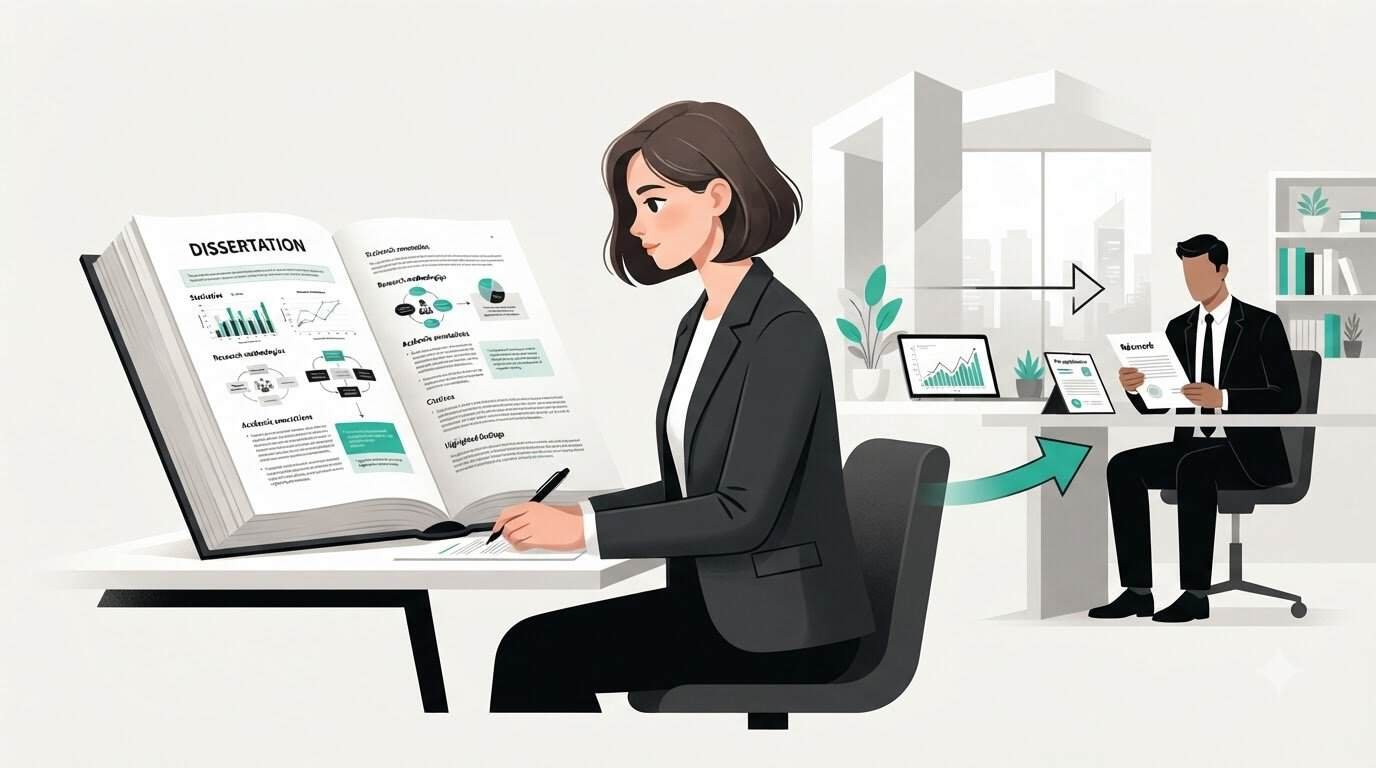
Table of Contents
You’ve spent months on your dissertation. Late nights, endless revisions, a committee that keeps sending your draft back with comments. Somewhere in the middle of all this, a question creeps in: will any employer even bother reading it? It’s usually the first question students ask a dissertation expert online, before they ask anything about grammar or formatting.
Short answer: mostly no, they won’t read the whole thing. But that doesn’t mean it doesn’t matter. It also doesn’t automatically speed up your hiring, since that depends entirely on how you use it in an interview or on your resume.
Career advisers at LSE and other university careers services agree on one thing: a dissertation is one of the strongest pieces of evidence you have of independent, complex thinking, if you know how to talk about it. This is where a good dissertation expert online can make the real difference, turning a dissertation that just sits in a repository into one that actually helps you get hired.
This article draws on twelve years of sitting across the table from dissertation students, in supervision-style meetings, methodology reviews, and last-minute data panics before a viva. That kind of repeated, hands-on exposure is what separates generic career advice from knowing exactly where dissertations actually go wrong, and how employers end up reading them later.
The Short Answer, It’s Complicated
Most career advice online gives you a flat yes or no. Neither is honest. The truth sits in between, and it depends on what job you’re chasing.
What Employers Actually Care About
Employers rarely care about your dissertation’s exact topic. They care about what the process proves about you. Can you plan a long project on your own? Can you handle setbacks, defend a position, and explain complex ideas simply?
That’s the real evaluation happening, even when the interviewer asks, “so, tell me about your dissertation.”
A lot of career blogs say employers want to hear “what you did.” We disagree with that framing. What actually lands well in an interview is what you learned and how you think, not a chapter-by-chapter summary. Students who treat the dissertation as a report to recite usually undersell it badly.
When the Topic Itself Does Matter
There are exceptions. If you’re applying to a pharmaceutical company and your dissertation involved drug interaction data, that topic is directly relevant and will get real attention. Same for a KYC or compliance role if your research touched financial crime. In these cases, your topic isn’t just a skill demonstration, it’s subject-matter proof.
What Your Dissertation Actually Proves to an Employer
Think of your dissertation as evidence, not decoration. Here’s what it actually signals when explained well.
- Sustained independent work. You built something over months without a manager checking in daily. Very few fresh graduates can prove this kind of self-direction.
- Deep expertise in one specific area. You likely know your dissertation topic better than anything else you studied. That kind of depth stands out against generic degree talk.
- Structured thinking. You formed a research question, gathered evidence, and reached a conclusion. That’s the same loop employers expect in strategy work, product decisions, and client problem-solving.
- Ability to take feedback. Every round of committee comments you survived is proof you can handle criticism without falling apart. That’s a real workplace skill, not an academic formality.
Some career sites frame the dissertation mainly as a “team player” signal because you consulted your advisor. We think that’s a stretch. One advisor relationship doesn’t prove teamwork.
What it does prove, convincingly, is that you can absorb tough feedback and improve your work because of it. Frame it that way instead.
Does the Field You’re In Change the Answer?
Yes, and this is the part most generic articles skip entirely.
STEM and Research-Heavy Roles
If you’re applying for a research scientist, data analyst, or lab-based role, your topic and your methodology matter a lot. Employers in these fields will genuinely dig into your data chapter. This is exactly where getting your analysis right the first time matters. Support with tools like SPSS, R, or Python data work, through data analysis support for your dissertation, pays off long before you sit for the interview.
Business, Consulting, and Marketing Roles
Here, the topic barely matters. What matters is how you narrate the skill behind it. A dissertation on rural healthcare access can absolutely support a consulting application. Talk about the framework, the stakeholder analysis, and the recommendation logic, not the healthcare specifics.
Career Switchers
If your dissertation has nothing to do with your target field, don’t hide it. Reframe it. Talk about the transferable skill, project management, data interpretation, or persuasive writing, and drop the subject-specific jargon entirely.
How to Actually Talk About Your Dissertation
This is where most graduates lose marks they should never lose.
Should You Put It on Your Resume?
Put it on your resume if you finished recently and have thin work experience, or if the topic is directly relevant to the role. If you already have two or more relevant internships or jobs, the dissertation usually moves down and shrinks to one line. If this is your first professional application, work experience doesn’t automatically outrank it; put it near the top.
Example resume line: “Dissertation: Analysed factors affecting employee retention in Indian IT firms using regression modelling on a dataset of 400+ respondents (SPSS).” One line, method named, scale named, done. That single line does more work than three vague bullet points ever will.
Should You Add It to LinkedIn?
Yes, in your Featured or About section, as a two-line summary rather than the full abstract. Lead with the question you answered and the one finding worth remembering, the same way you would in an interview. Recruiters skim LinkedIn profiles in seconds, so this is not the place for academic phrasing.
The 60-Second Interview Formula
When asked “tell me about your dissertation,” don’t summarise the whole thing. Use this structure instead:
- State the research question and why it mattered.
- Name the method you used, briefly.
- Share the key finding.
- End with what you learned about your own thinking or field.
That sequence takes under ninety seconds and answers the actual question being asked: can you think clearly under pressure? It also mirrors the STAR method (Situation, Task, Action, Result) that most interviewers already use to score answers. Structuring your dissertation story this way scores extra points without extra effort on your part.
Common Mistakes
The biggest mistake is dumping the entire chapter structure on the interviewer. Nobody wants that. The second biggest is picking a controversial topic and then avoiding it entirely out of nervousness. Career advice platform Welcome to the Jungle makes a similar point: you don’t need to dodge a sensitive topic, you just need a calm, factual way to discuss it if it comes up.
What a Dissertation Expert Online Actually Does (And Doesn’t Do)
This needs to be said plainly, because a lot of services online blur this line badly.
What does a dissertation expert online actually do? An expert dissertation writer or thesis writing expert, used correctly, is someone who strengthens your writing, argument, and data analysis without producing the document for you. It does not mean someone writes your dissertation instead of you. If a service offers to write your dissertation for submission, that’s ghostwriting, and it puts your degree at risk.
A genuine dissertation coach or dissertation mentor works differently. They help you understand your committee’s dissertation expectations, clarify your methodology, check your statistics are sound, and improve your structure through feedback rounds, the same way a good editor works with an author. The thinking and the writing stay yours.
Call this person a thesis writing expert or a dissertation coach; the job description stays the same, sharper argument, not replaced thinking. One-on-one dissertation and data support is built around exactly this line.
Why This Distinction Protects You
Committees check for originality. Employers, later, may ask detailed questions about your findings in an interview. If you can’t answer those questions because someone else wrote your dissertation, that’s a bigger risk than any coaching fee saved.
What to Look for in Dissertation Editing Services Near Me
- They explain, not just correct. A good editor tells you why a section is weak.
- They’re transparent about what they will and will not touch.
- They have real experience with your specific software, whether that’s SPSS, R, or Stata for your data chapter, through SPSS help for your dissertation data.
- They don’t promise guaranteed committee acceptance, since no honest service can.
If you’re looking for a dissertation expert UK based service versus a US one, the standards above don’t change, but the resume conventions do. In the UK, a dissertation typically sits as a short line under your degree entry on the CV. In the US, it’s more common to give it its own short paragraph, especially for a first role after a master’s or PhD. American resumes for research-heavy fields tend to run longer and more detailed anyway.
Statssy’s lead dissertation mentor has spent over 12 years working with graduate students across the UK, US, and Australia. Most of that work happens in the data and statistics chapters, which is where dissertations tend to fall apart under committee scrutiny.
Five Common Dissertation Problems We Fix (From 12 Years of Guiding Research)
Across twelve years of dissertation supervision and data support, the same five problems show up again and again, across countries and subjects. These are anonymised patterns, not any single student’s story, but each one repeats often enough to be worth knowing before your committee catches it first.
- The research question was too broad to answer. A common early-stage problem is something like “the impact of social media on society,” which isn’t researchable inside one dissertation. The fix is narrowing it to something testable, for example the effect of daily Instagram use on body image perception among a specific, defined group of undergraduates.
- The aim was written as an intention, not an objective. “To explore how leadership affects performance” sounds fine but can’t be measured or defended. Rewriting it as something like “to examine the relationship between transformational leadership style and employee performance in mid-sized manufacturing firms” gives the dissertation an aim the student can actually test and answer questions on.
- The methodology didn’t match the question. One student wanted to understand why employees leave a company, a qualitative, experience-driven question, but had already committed to a closed-ended quantitative survey. Realigning the method to the question, before data collection starts, is one of the most common fixes, and one of the most expensive to skip.
- The wrong statistical test was used on the data. This shows up constantly: a Pearson correlation run on ordinal Likert-scale responses, or an independent t-test used across three groups instead of an ANOVA. Committees flag these hard. Matching the test to the actual data type is often the fastest, highest-impact fix in an entire dissertation review.
- The structure buried the argument. Some dissertations have all the right content in the wrong order, findings scattered across chapters instead of building logically from literature to method to result to discussion. Restructuring around one clear argument, chapter by chapter, usually improves the final grade more than adding new content ever does.
Quick Decision Checklist
Ask yourself these before deciding how much weight to give your dissertation in a job search:
- Is the role research-heavy or technical? If yes, your topic matters more.
- Is the role client-facing or strategy-based? If yes, your process matters more than your topic.
- Do you already have two or more relevant jobs or internships? If yes, keep the dissertation mention brief.
- Are you a recent graduate with a thin resume? If yes, your dissertation is one of your strongest assets; use it fully.
- Does the role weigh your degree classification or GPA heavily? If yes, that number usually outranks your dissertation grade specifically.