
15 Common Dissertation Discussion Chapter Mistakes (and How to Fix Them)
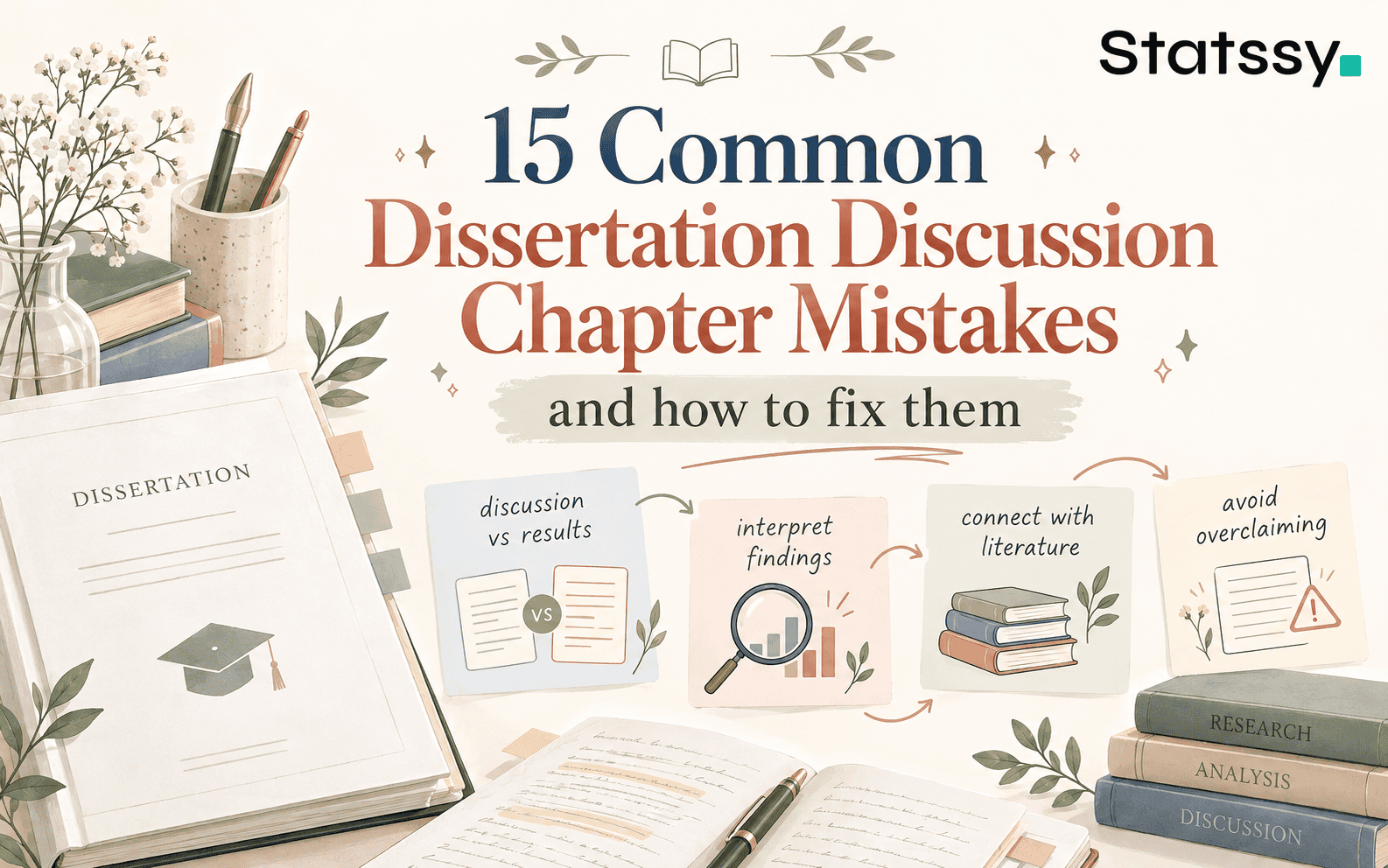
The 15 mistakes covered in this guide
- Repeating results instead of explaining their meaning
- Organising the chapter by statistical test instead of by research question
- Blurring the discussion into the conclusion with no distinction
- Confusing statistical significance with practical significance
- Making causal claims from correlational data
- Treating a non-significant result as proof there is no effect
- Ignoring or downplaying contradictory findings
- Never comparing findings back to the literature review at all
- Citing literature without actually engaging with it
- Dismissing studies that contradict your findings instead of addressing them
- Overstating practical, policy, or real-world implications
- Opening the discussion chapter with limitations instead of findings
- Listing limitations without explaining their impact on the findings
- Inserting personal opinion or unsupported speculation
- Ending with a vague “more research is needed” and no specific gap
Why Dissertation Discussion Chapter Mistakes Begin With Discussion vs Results Confusion
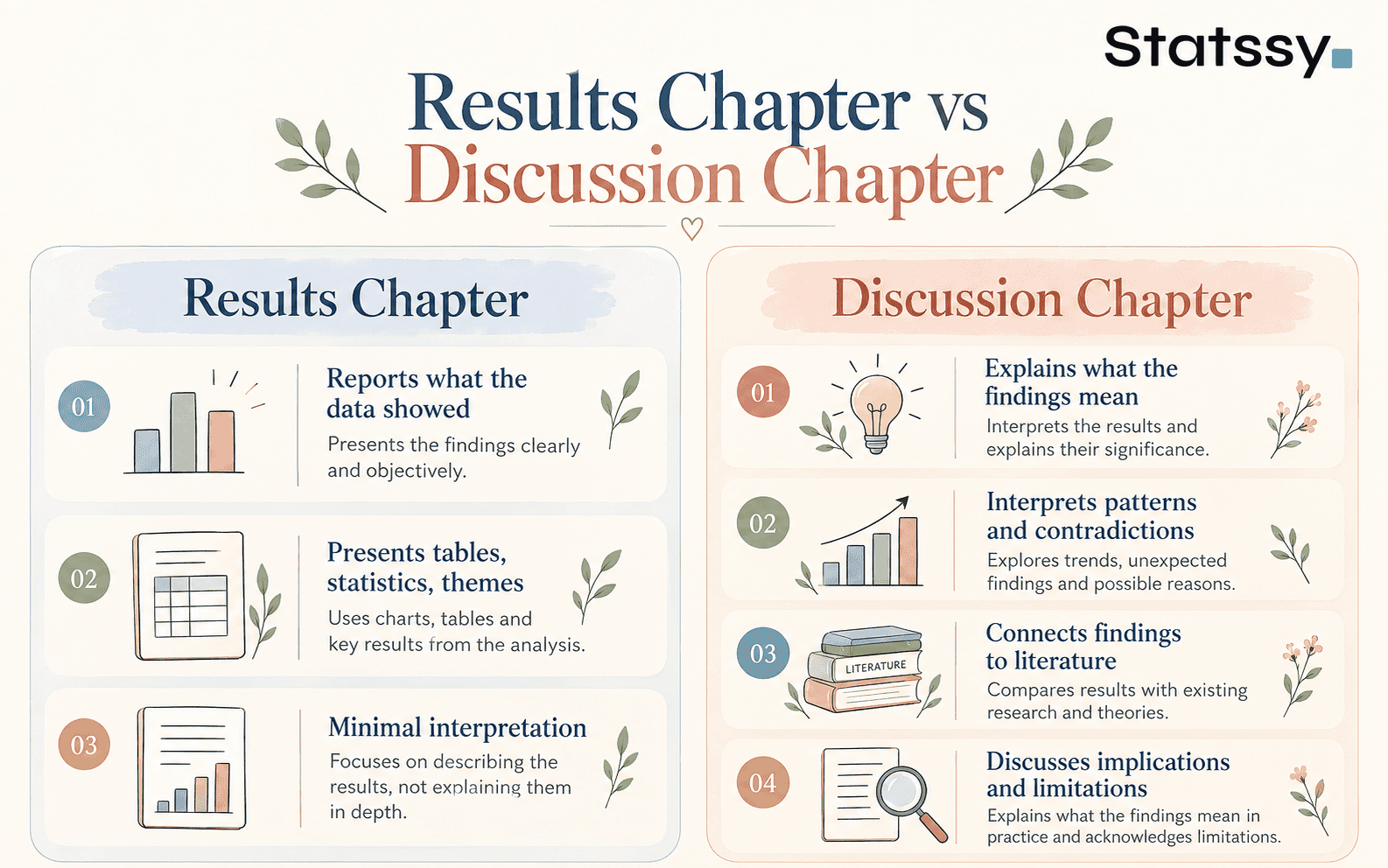
Most of the dissertation discussion chapter mistakes I come across after twelve years of reading drafts start with one habit. Students write the discussion as if it were a second results chapter, just with longer sentences.
A results chapter reports what the data showed. A discussion chapter explains what that finding means, why it happened, and why anyone outside your committee should care. If you cannot tell which chapter a paragraph belongs to, your reader cannot either, and that confusion is usually the first thing a supervisor flags.
This holds whether your dissertation is quantitative, qualitative, or mixed methods. A qualitative discussion chapter interprets themes and participant quotes the same way a quantitative one interprets a regression table, by explaining what a theme means and why it matters, not simply restating that it came up.
If you are not yet sure what belongs in Chapter 4 versus Chapter 5, our guide to understanding what belongs in the results chapter sorts that out before you write a word of the discussion.
I have sat across from students who could run a regression perfectly in Chapter 4 and then spend Chapter 5 restating the same numbers in paragraph form. That is not discussion, that is restatement with extra words, and examiners notice within the first page. If you want your chapters properly organised before you even reach this stage, our dissertation organising guide is a good place to start.
Scribbr’s FAQ page on this exact question answers it in two lines, which is useful if all you need is the one-sentence definition. It does not get into why the mix-up actually costs marks, or what a graded discussion chapter looks like once the two are properly separated, which is the gap this guide is written to close.
Here are the common mistakes in your dissertation discussion chapter that I see most often, grouped by where they actually go wrong, structure, interpretation, literature connection, implications, and tone. Fifteen mistakes, with the fix for each one.
Common Mistakes in Your Dissertation Discussion Chapter Structure
Mistake 1, repeating results instead of explaining their meaning
This is the one I flag most. A paragraph says “the mean score was 4.2, higher than the control group’s 3.1” and stops there. That sentence belongs in Chapter 4. The discussion needs the next sentence too, why that gap matters, what it tells you about your hypothesis, and how it compares with earlier studies.
Our guide on separating statistical reporting from interpretation walks through exactly where APA-style SPSS reporting should stop and genuine interpretation should begin.
The fix. Every time you state a number, follow it with one sentence that answers “so what.” If you cannot write that sentence, you have not actually understood the finding yet, and that is worth sorting out before you submit, not after your viva or your defense.
Mistake 2, organising the chapter by statistical test instead of by research question
I have read discussion chapters structured as “ANOVA results,” then “regression results,” then “correlation results.” A reader has to hunt across three sections just to find out what happened to a single research question.
The fix. Organise by research question or hypothesis instead, and bring in whichever test supports that particular answer.
Mistake 3, blurring the discussion into the conclusion with no distinction
Some drafts run the discussion straight into general statements about the field with no signal that interpretation has ended and summary has begun. A reader should be able to tell, without a heading, when you have moved from “here is what this means” to “here is the overall takeaway.”
The fix. One short transition sentence does the job, something as simple as “taken together, these findings suggest.”
A pattern I see often looks like this. An MBA student’s discussion chapter is technically strong but reads as one long paragraph of findings, implications, and conclusions stitched together. Splitting it into three clearly signposted movements, interpretation, implications, and a short closing synthesis, is usually all it takes for a supervisor’s next comment to go from confused to far clearer now. Nothing in the content changes. Only the shape does.
Editage’s guide to this chapter covers the standard template well, results, interpretation, implications, limitations, in that order. But it treats structure as the whole problem. In my experience the template is rarely the issue, a student who has all four sections in the right order can still write an unreadable chapter if each section just restates the last one in different words, which is exactly what Mistakes 1 to 3 above are about.
How to Interpret Findings in Your Dissertation Discussion Without Overclaiming
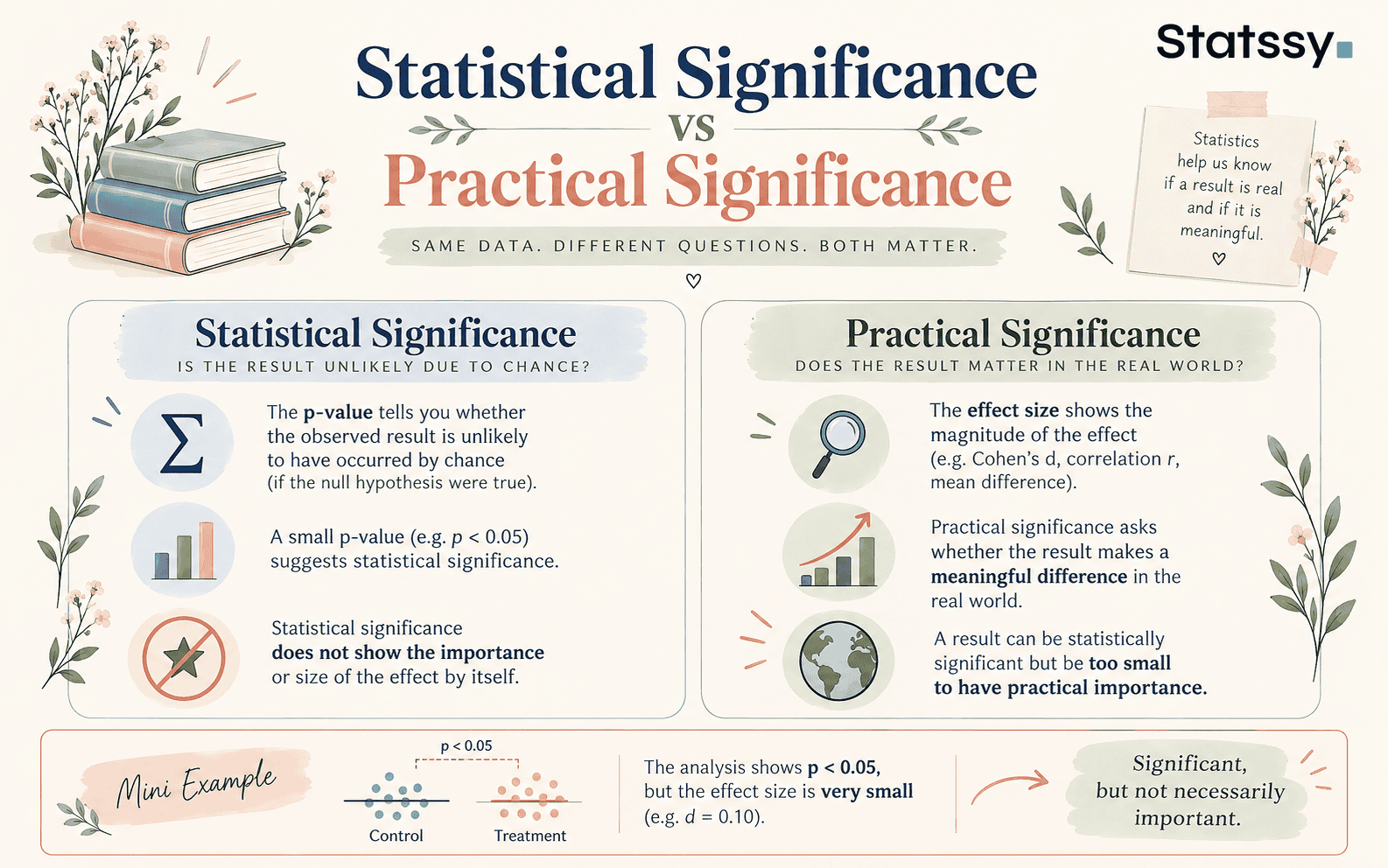
Mistake 4, confusing statistical significance with practical significance
A p-value under 0.05 tells you the result is unlikely to be chance. It does not tell you the result is large, important, or worth acting on. I have read discussion chapters that treat a tiny effect size as a breakthrough purely because the significance test passed. A single test statistic, like the one covered in our Durbin-Watson test interpretation guide, gets over-read the same way when students treat “the assumption is met” as proof the whole model is sound.
The fix. Report the effect size next to the p-value, and say in plain words whether the effect is large enough to matter outside a statistics class. The same over-reading happens with assumption checks like the Shapiro-Wilk normality test or variance inflation factor, where “the test passed” quietly becomes “therefore the model is correct.”
Mistake 5, making causal claims from correlational data
This is the mistake examiners flag hardest, and for good reason. If your design was correlational, cross-sectional, or survey-based, you cannot write “X causes Y.” You can write “X is associated with Y” and then discuss why that relationship might exist. Our guide on Pearson vs Spearman correlation is worth a look if you are unsure which coefficient even applies to your data before you get anywhere near causal language.
A confounding variable neither side of your correlation accounts for could be driving both of them at once, which is exactly why causal language needs more than a significant correlation behind it.
Mistake 6, treating a non-significant result as proof there is no effect
A non-significant result means you did not find evidence of an effect in this sample. It does not mean the effect does not exist. I see students write off a whole research question as a failure because the p-value came in at 0.08, when the honest line is that the result was inconclusive, possibly due to sample size.
A small or underpowered dataset is not a dead end either, it just means your interpretation should talk about what the data could not detect, rather than overclaiming what it did.
Our piece on discussing nonsignificant findings appropriately goes through exactly how to word this without making your study sound like it failed.
Mistake 7, ignoring or downplaying contradictory findings
If part of your data supports your hypothesis and part does not, address the part that does not. Burying a contradictory finding in a single clause, or leaving it out altogether, is the fastest way to lose an examiner’s trust once they cross-check your own tables.
The fix. Give the contradictory result its own sentence, offer one possible reason for it, and connect that reason back to your method or sample.
We cover this in more depth in our guide to interpreting findings that do not support the hypotheses.
A pattern I see often in finance dissertations looks like this. Three hypotheses come back supported and one flatly contradicts the prediction, and the first draft mentions that contradiction in half a sentence before moving on. Rewriting that section to actually sit with the contradiction, offer two possible explanations, and tie it back to a limitation in the sampling frame, is usually the one paragraph an external examiner ends up asking the most about, in a good way.
Statistics Solutions has a solid reference page on discussing findings, and it is correct on the mechanics, state the finding, link it to the hypothesis, note the significance. What it does not spend much time on is the over-claiming side, treating significance as proof of importance, which in my own marking is where more marks are actually lost than on the mechanics themselves.
How to Connect Findings With Literature Review the Right Way
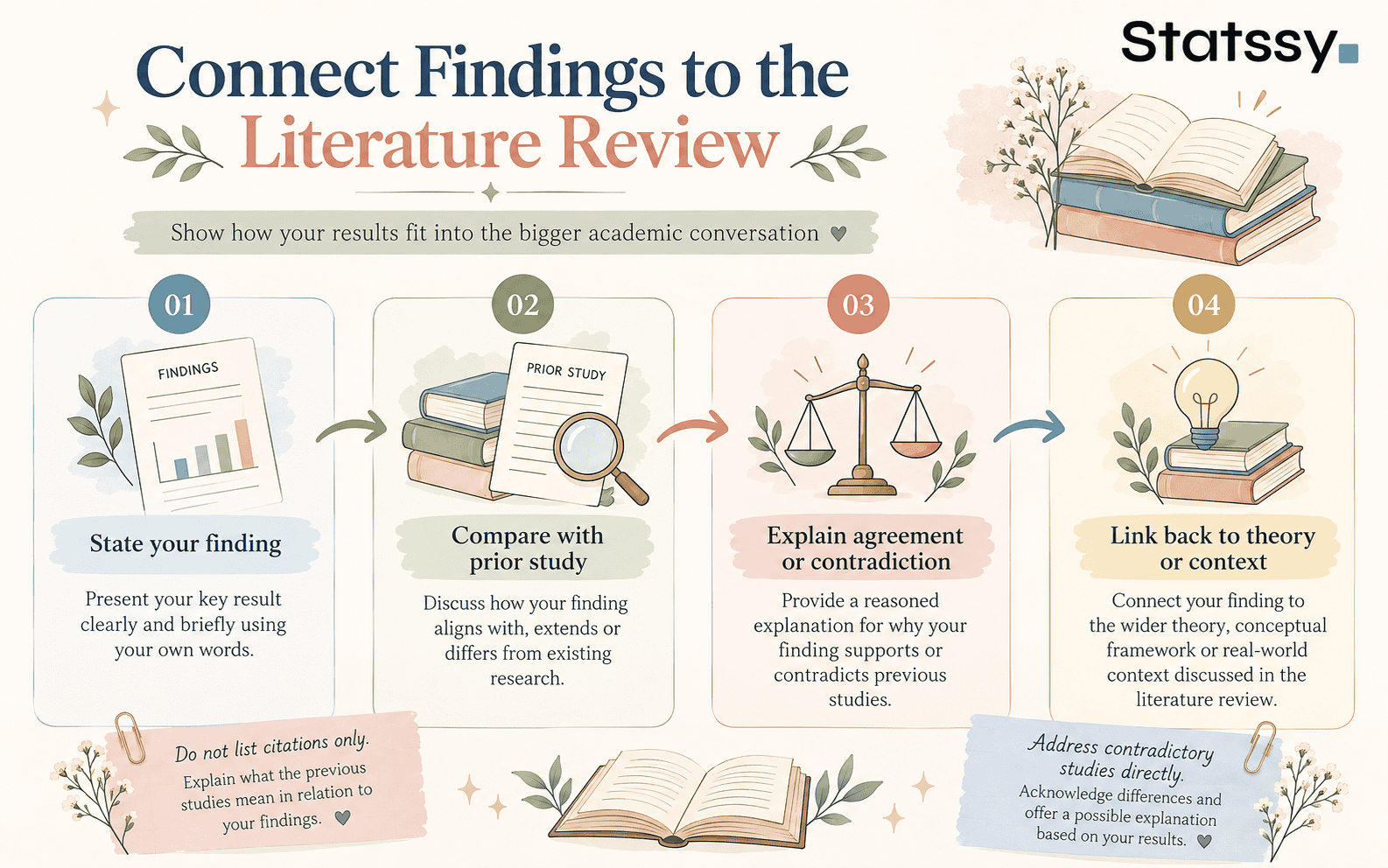
Mistake 8, never comparing findings back to the literature review at all
A discussion chapter that interprets results purely on their own terms, with no reference to what earlier studies found, is only doing half the job. Your committee wants to know where your study sits relative to the field, not just what you found in isolation.
The fix. Name at least one specific prior study next to every major finding, and say plainly whether you agree or disagree with it.
Our guide on connecting findings with existing literature walks through exactly how that comparison should read.
Mistake 9, citing literature without actually engaging with it
This is the “literature dump,” a string of citations with no comparison drawn. Writing that a finding aligns with three named authors in a row is not comparison, it is a list. State specifically where your finding matches theirs, where it diverges, and offer a reason for the divergence.
The fix. Replace a string of citations with one sentence that says exactly where your finding agrees or disagrees with each one.
Mistake 10, dismissing studies that contradict your findings instead of addressing them
If your result disagrees with a well-established prior study, do not quietly leave that study out of the discussion. Engage with it directly. Differences in sample, context, measurement, or time period are usually enough to explain the gap, and naming that explanation shows real scholarly maturity.
The fix. Name the contradicting study directly and offer a concrete reason for the gap, sample, method, or context, rather than leaving it out.
Our piece on relating the findings back to the theoretical framework is worth a look if this connection feels thin in your own draft.
I read a widely cited piece from Enago Academy while researching this topic. It frames the discussion chapter mainly around a fixed order, structure first, then implications, then limitations. What actually costs marks, in my own marking experience, is not the order you cover things in, it is silence on the studies that disagree with you. Arrange the chapter however reads most naturally for your argument, just do not skip the uncomfortable comparison.
Getting Implications and Limitations Right
Mistake 11, overstating practical, policy, or real-world implications
A sample of forty undergraduates at one university does not justify a line like “these findings should inform national policy.” Scale your implications to your sample and design. A smaller, honest claim is more credible than a sweeping one that cannot survive a follow-up question in the viva or the defense.
This is really a question of generalisability, whether your specific sample and context can stand in for the wider population your implication is reaching toward, and a sample of forty from one university usually cannot.
The fix. State your implication at the same scale as your sample and design, and avoid phrases like “should inform policy” unless your data can actually carry that weight.
Mistake 12, opening the discussion chapter with limitations instead of findings
I have seen drafts that open the discussion with two pages on what went wrong with the sample before the reader has even learned what was found. Lead with your interpretation and implications. Limitations belong after that, not before it.
There is an older but still widely cited piece from APA’s GradPsych on this exact point. It specifically warns against opening the discussion with limitations, because doing so makes the dissertation read as though it raised more questions than it answered. I agree with that framing, though I would push it one step further than the piece does. Limitations placed too late, right at the very end with nothing after them, create the same problem in reverse, and the chapter needs a closing line after them, not a trail-off.
The fix. Move limitations after your interpretation and implications, never before them, and add a closing line after them so the chapter does not trail off.
Mistake 13, listing limitations without explaining their impact on the findings
“Sample size was small” is not a limitation statement, it is half of one. The second half, how that sample size specifically affects how much weight your findings should carry, is the part that actually matters and the part most drafts skip.
The fix. After naming each limitation, add one sentence on exactly how it changes the weight your findings can carry.
If a supervisor has already pushed back on your approach here, our guide on addressing methodological concerns raised by your supervisor is worth reading before your next redraft.
Mistakes That Quietly Damage Your Credibility
Mistake 14, inserting personal opinion or unsupported speculation
A discussion chapter interprets data, it does not argue personal belief. A sentence like “I feel this happened because society today values X,” with no citation or data behind it, weakens an otherwise strong chapter. If you believe something explains your finding, find a source or a piece of your own data that supports it, or flag it clearly as a speculative explanation worth testing in future research.
This is also where I would flag a newer risk that older guides on this topic do not cover at all, over-relying on AI tools to generate the interpretation itself. An AI-written interpretation can sound confident and still introduce a causal claim your data does not support, or miss a contradiction a trained eye would catch straight away. If you have used AI tools anywhere in your analysis or drafting, run the output through something like our guide on verifying AI-generated dissertation analysis before it goes anywhere near your final draft. And if a supervisor has already flagged a chapter as sounding AI-written, our pieces on what to do if your supervisor says your dissertation sounds like AI and how to respond if you are accused of using AI in your dissertation cover the next steps.
The fix. Back every explanatory claim with a citation or your own data, or label it clearly as a speculative idea for future research.
Mistake 15, ending with a vague “more research is needed” and no specific gap
This is the laziest closing line in dissertation writing, and examiners have read it hundreds of times. Name the actual gap your study leaves open, and say specifically what kind of future study would close it, a different sample, a different method, a longitudinal design instead of a cross-sectional one, whatever applies to your case.
The fix. Name the exact gap your study leaves open and the exact kind of future study that would close it.
Our guide on checking whether the findings answer the research questions is a quick gut-check before you finalise this section.
How to Improve Your Dissertation Discussion and Conclusions Before You Submit
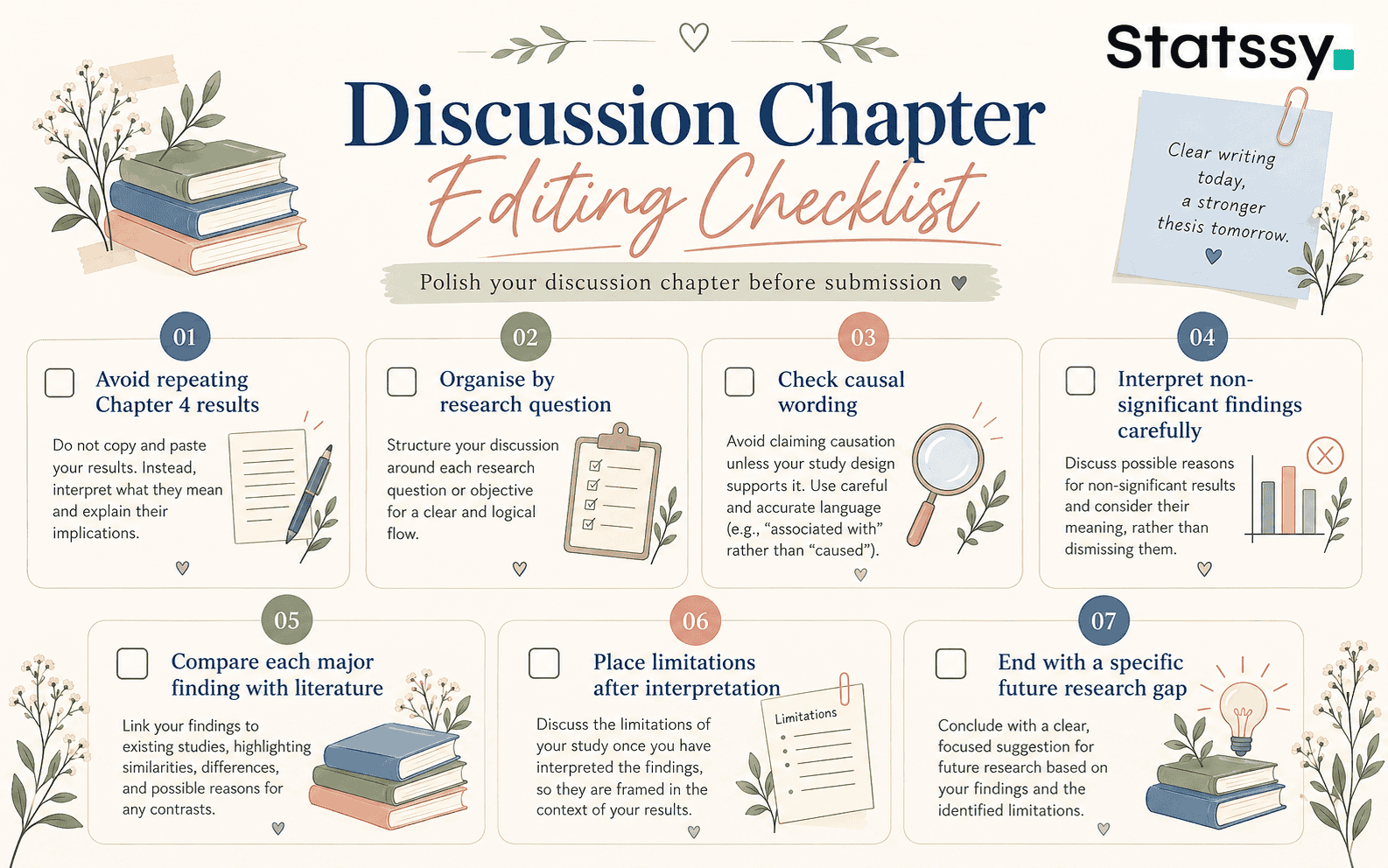
If you only have an evening before your deadline, work through this list in order. It catches most of the fifteen mistakes above in about an hour of editing.
- Read only your discussion chapter, out loud, and mark every sentence that simply repeats a number from Chapter 4.
- Check that every research question gets its own clearly interpreted answer, not just a mention.
- Circle every causal word, “causes,” “leads to,” “results in,” and confirm your design actually supports that word.
- Find every p-value above 0.05 and confirm you have not quietly called it “no effect.”
- Confirm every major finding is compared with at least one specific prior study, by name, not a general citation list.
- Move any limitations section so it follows your interpretation and implications, not before them.
- Rewrite your closing paragraph so it names one specific gap and one specific next study, not a generic call for “more research.”
If working through that list raises more questions than it answers, that is usually a sign the chapter needs a second set of eyes rather than another solo read-through. That is normal this late in a dissertation, and it is exactly how to know if you need a dissertation expert to confirm before submission rather than after your viva or your defense.
That is the full list of dissertation discussion chapter mistakes I see most often in twelve years of this work, and the fixes that actually hold up under a committee’s questions.
If you want a version of this checklist you can print and mark up by hand while you do your own read-through, save this page, it is built to be used exactly that way before you submit.
Frequently Asked Questions
What is the difference between a dissertation discussion vs results chapter?
The results chapter reports what you found, with no interpretation. The discussion chapter explains what that finding means, why it happened, and how it connects to earlier research. If a sentence explains “why,” it belongs in the discussion, not the results.
How long should a dissertation discussion chapter be?
Most discussion chapters run between 3,000 and 6,000 words, roughly 15 to 20 percent of the full dissertation, though this varies by university and discipline. Check your department’s handbook for an exact figure before you rely on a general range.
Can the results and discussion chapters be combined?
Yes, in some disciplines and at some universities this is standard, and in qualitative research it is often preferred. Check your programme’s guidelines first, since this varies more by institution than by subject.
How do you interpret statistically significant results in a discussion chapter?
Report the p-value alongside the effect size, then explain in plain language whether that effect is large enough to matter in practice, not just in theory. A statistically significant result with a tiny effect size is still worth naming as such.
How do you discuss limitations without weakening your dissertation?
Place limitations after your main interpretation and implications, explain the specific impact each limitation has on your findings, and close with how future research could address them. A limitations section that explains impact reads as scholarly honesty, not weakness.
What is the difference between the discussion chapter and the conclusion chapter?
The discussion interprets each finding in depth and engages closely with the literature. The conclusion steps back and briefly summarises the whole dissertation’s contribution. In many master’s and undergraduate dissertations, the two are combined into one chapter.
What should I expect if my examiner questions my discussion chapter in the viva or defense?
Most discussion-chapter questions in a viva or defense target exactly the weak points this guide covers, an unsupported causal claim, a limitation you did not fully explain, or a contradictory finding you glossed over. Reread your discussion chapter looking specifically for those three things a day or two before your viva or defense, and you will have an answer ready for most of what comes up.