
Supervisor Rejected Statistical Analysis? Here’s What to Do Next
When a supervisor rejected statistical analysis you spent months building, the first feeling is never logic. It is panic. I have sat with students in exactly this spot more times than I can count across twelve years of guiding dissertations, and I can tell you this upfront: it is almost never as bad as it feels on day one.
In my experience, this exact question spikes every exam season, right on schedule. You are not uniquely bad at this. You landed in one of five very specific, very fixable situations, and this article walks through exactly which one and what to do about it.
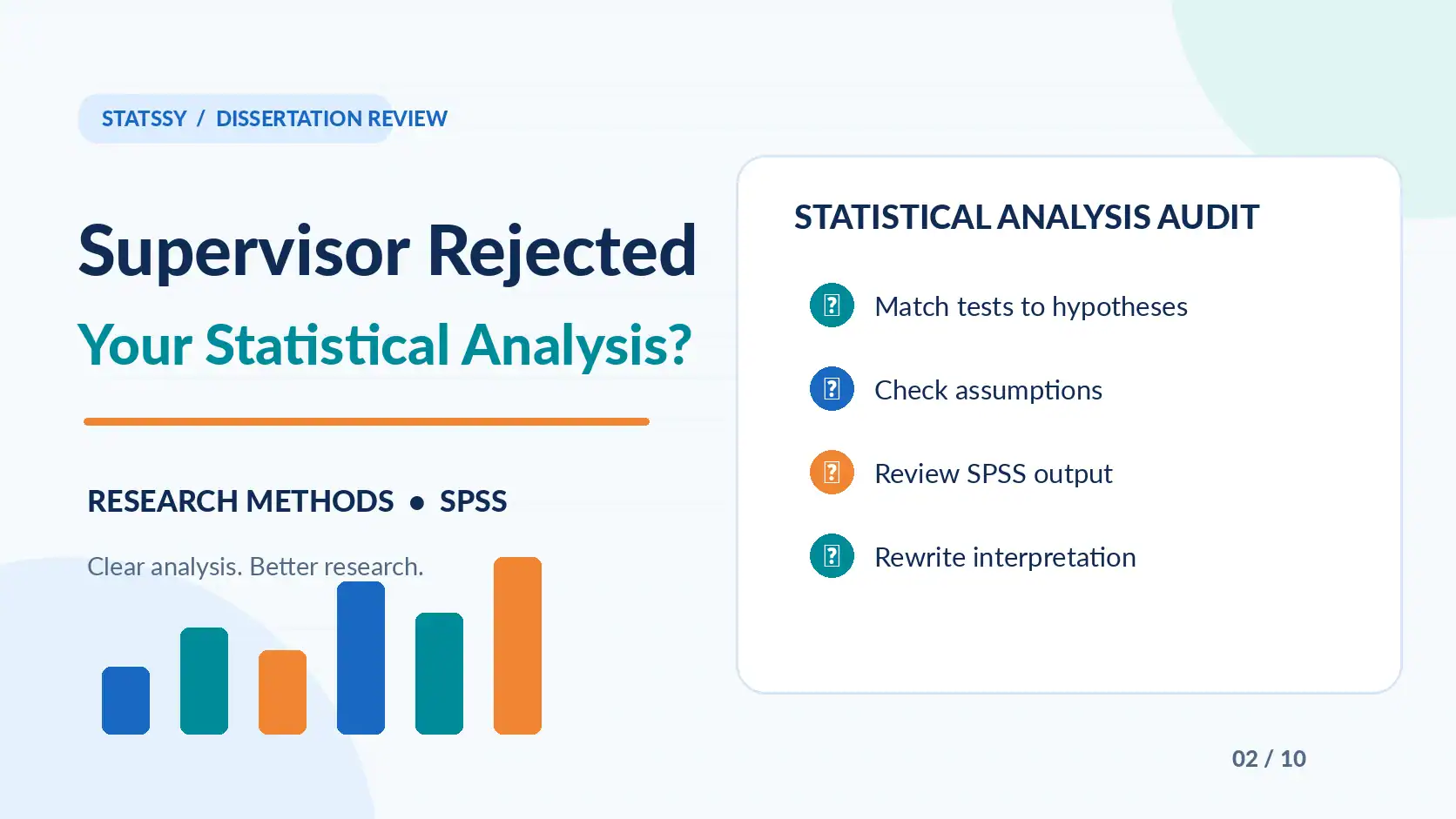
What does it mean when a supervisor rejects a statistical test? It usually means one of five things went wrong: the wrong test for your design, a broken assumption, too small a sample, a misread output, or the wrong software for what your department expects. It rarely means your research question or your data are unusable.
Why Do Supervisors Reject Statistical Tests So Often?
Here is something nobody tells you in your methods course. Most statistics modules teach you how to run a test. Very few teach you how to defend your choice of test when someone with more experience questions it.
That gap is where almost every rejection I have seen actually comes from. The student did the analysis correctly by the textbook, but could not explain why that particular test fit that particular design. Supervisors pick up on that gap instantly, even when the maths is fine.
I have read a fair number of generic consulting articles on handling committee feedback statistics. Most of them spend three paragraphs telling you to stay calm and communicate professionally with your chair. Fine advice, but close to useless if you still do not know what is actually wrong with your test.
The 5 Real Reasons Supervisors Reject Statistical Analysis
In order of how often I actually see them.
1. Wrong test for your research design
Running an independent-samples test on paired or repeated data is the single most common one I see. A close second is using Pearson’s correlation on data that is clearly ordinal or non-normal, when a Spearman correlation would have been the honest choice. With categorical data, forcing a chi-square test onto expected cell counts below five is a frequent variant of this same mistake. This is also where post hoc test selection trips people up, choosing Tukey when Games-Howell was the correct call for unequal variances.
2. Violated statistical assumption
Normality, homogeneity of variance, or independence was never checked, and it shows. When an assumption fails entirely, the honest fix is often a non-parametric alternative altogether, swapping a t-test for Mann-Whitney U rather than forcing a parametric test the data was never built for. Regression students get hit here too, through unchecked multicollinearity or autocorrelated residuals that a Durbin-Watson check would have flagged early.
3. Underpowered sample size
An underpowered sample size means your study had too few participants to reliably detect a real effect, even if one truly exists. Nobody ran a power calculation before data collection, so the result cannot be trusted either way, significant or not.
4. Misreported or misread output
The test was fine, but the write-up got the degrees of freedom, p-value, or direction of the effect wrong.
5. Wrong software for your department’s expectations
Some committees expect R or Stata syntax for transparency, and an SPSS point-and-click output alone will not satisfy them.
How to Diagnose Which One Is Actually Yours
Before you touch your analysis again, re-read your supervisor’s comment slowly and ask three questions.
- Did they question the test itself, or the numbers you reported? That tells you if it is cause 1 or cause 4.
- Did they name a specific assumption, like normality or variance? That is cause 2. Ignoring a violated assumption quietly raises your risk of a Type I error, a false positive your committee is trained to catch, which is exactly why they flag it early.
- Did they ask anything about your sample size or power? That is cause 3.
Most rejections map to exactly one cause, not all five at once. Figuring out which one saves you days of unnecessary redo work. If you have read your supervisor’s comment three times and still cannot place it in any of these five buckets, that uncertainty itself is worth a second opinion before you resubmit (how to know if you need a dissertation expert).
Need help with supervisor rejected statistical analysis?
Get tailored help reviewing your methodology and statistical output.
Review My Analysis on WhatsAppThe Fix for Each Cause
Fixing a wrong test selection
Go back to your research question and your data structure first, not the test name. If your data is pre-test and post-test on the same people, you likely need a paired approach, not an independent one (paired t-test vs repeated measures ANOVA guide).
Fixing a violated assumption
Run the actual diagnostic test and report it, do not just eyeball a histogram. For normality, this means the Shapiro-Wilk test alongside Levene’s test for equal variances. For regression, check multicollinearity with the VIF guide.
Fixing an underpowered sample
If data collection is finished, you usually cannot add participants before a deadline, but you can run a post-hoc power calculation honestly and report it as a limitation rather than hiding it. For future studies, calculating sample size before collection using a sample size calculator avoids this entirely.
Fixing a misreported output
Pull the raw output again and re-check every number against proper APA reporting conventions, specifically degrees of freedom, exact p-values, and effect size, using a reliable reference such as Scribbr’s APA statistics reporting guide. This is the fastest fix on this list, often under an hour.
Fixing a software mismatch
Ask your supervisor directly which software and version your department expects for transparency. Re-running the same test in R using open syntax usually satisfies this without changing a single conclusion.
Real Case: From Rejection to Approval
A Masters candidate in the UK came to me after her supervisor rejected her pre-post intervention analysis outright. She had run two independent-samples t-tests comparing her intervention and control groups at baseline and follow-up separately, each reported as its own result.
The problem was not her maths. Her design was within-subjects on one group and between-subjects on the other, and she had treated both the same way, which is exactly cause 1 on the list above. We restructured the analysis as a mixed ANOVA, re-ran it over a weekend, and resubmitted with a clear paragraph explaining why the design demanded that specific model.
Her supervisor approved it on the next read, with one minor comment about rounding in the effect size table, which we fixed in ten minutes. Nothing about her data or her findings changed, only the test matched the design, and the explanation matched the test. She defended her viva three weeks later without a single statistics question.
How to Respond to Committee Feedback on Statistics
If you are searching how to respond to committee comments without sounding defensive, start by separating what you genuinely agree with from what you do not.
When you agree: Say so plainly, state the fix you are making, and give a realistic timeline. Committees respond well to specificity.
When you disagree: Do not argue in the margins of the document. Ask for five minutes to explain your reasoning verbally, and bring the statistical justification, not just an opinion. This is exactly why some universities run dedicated statistical consulting centres, such as Indiana University’s peer review feedback support, because interpreting committee feedback statistics is its own skill, separate from running the analysis itself.
A simple template that has worked for my students:
“Thank you for this comment. I have reviewed it and [agree / would like to discuss further]. [If agreeing: I have addressed this by running X, and the revised result is Y.] [If discussing: My reasoning for the original approach was Z, happy to walk through this if useful.]”
How Long Will This Actually Take, and What Does It Cost
Most fixes in this article take between two hours and three days, not weeks. Wrong test selection and misreported output are usually same-day fixes once you know the cause. Underpowered samples and software switches take longer only because they involve waiting on a supervisor’s sign-off, not because the statistics itself is hard.
If you are paying for help rather than fixing it yourself, cost is driven almost entirely by which of the five causes you have, not by how serious the rejection feels. A misreported output or a wrong-test correction is typically the cheapest and fastest to resolve. An underpowered sample or a full software migration takes longer and costs more, simply because there is more work to redo, not because anyone is charging a premium for a dissertation in distress.
Need help with revising dissertation tests and assumptions?
Get tailored help reviewing your methodology and statistical output.
Review My Analysis on WhatsAppFAQ
Can a dissertation be rejected just because of one statistical test?
Rarely the whole dissertation, but it can delay your defence, or viva as it’s called in the UK, by weeks if left unaddressed, since Chapter 4 is usually the gatekeeper chapter.
SPSS or R, which do committees prefer?
It depends entirely on your department. Some prefer R for transparency of syntax, others are fully comfortable with SPSS output. Ask directly rather than assuming.
Can I change my analysis after already submitting a draft?
Yes, this is completely normal and expected at draft stage. Committees expect revisions between Chapter 4 submission and final approval.
How long does it typically take to fix a rejected statistical test?
Most individual causes take two hours to three days of actual work, though committee turnaround time for re-review adds separately.
What if I genuinely disagree with my supervisor’s feedback?
Request a short verbal discussion and bring your statistical reasoning, not just your opinion. Most disagreements resolve once both sides see the same justification. If the relationship itself feels strained, it may also help to read about finding a dissertation writing mentor for a second, neutral opinion.
How do I know if my sample size was underpowered?
Run a power calculation using a tool like G*Power, ideally before data collection, and report the result honestly in your limitations section rather than ignoring it.
Is it my fault, or is my supervisor being unreasonable?
Usually neither. Most rejections come from a genuine mismatch between test and design that is easy to miss under deadline pressure, not from carelessness on your part or unfairness on theirs.
If you have read through all five causes above and you are still not sure which one applies to your specific feedback, that is normal, and it is usually faster to have a second pair of eyes look at the actual comment than to guess. Feel free to reach out directly if you would like a quick read on your situation.
Siddharth Gupta has spent twelve years guiding dissertation and thesis students through exactly this situation, working across statistical software, research designs, and committee expectations in the UK, USA, and beyond. Connect on LinkedIn.