
10 Dissertation Abstract Mistakes (With Before-and-After Examples)
Table of Contents
Dissertation abstract mistakes are the fastest way to lose marks on a section you can fix in one sitting. These are the ten errors I check first when a student sends me an abstract, from missing aims to findings that never appear. Below, I show each mistake, why it costs marks, and a one-line fix. You also get two full before-and-after rewrites and the US and UK word limits side by side.
What Is a Dissertation Abstract?
A dissertation abstract is a standalone summary of your whole study, usually 150 to 350 words. It states your aim, methods, main findings and conclusion in one short passage, and adds nothing that is missing from the dissertation itself.
Key takeaways
– Word limit: Newcastle and Leicester cap the abstract at 300 words. NDSU allows 350 words for doctoral dissertations and 150 for master’s work. Programmes differ, so confirm your own handbook before trimming.
– Structure: aim, method, findings, conclusion, implications, in that order.
– Costliest errors: the most costly dissertation abstract mistakes are missing findings, vague methods and conclusions that go beyond the data.
– Rules differ by university: UEA counts the abstract inside the thesis word count, but the Open University leaves it out for PhD and MPhil theses.
– Timing: write the abstract last, then recheck it after your final corrections.
The 10 Dissertation Abstract Mistakes at a Glance
- No clear aim or research question
- A background that eats your word count
- Unclear methods
- No actual findings
- Conclusions your data cannot support
- New information that is not in the dissertation
- Ignoring the word and page limit
- Citations, statistics dumps, bullets and unexplained jargon
- No implications and weak keywords
- Writing it first and never revising it
Dissertation Abstract Structure: The 5-Part Model
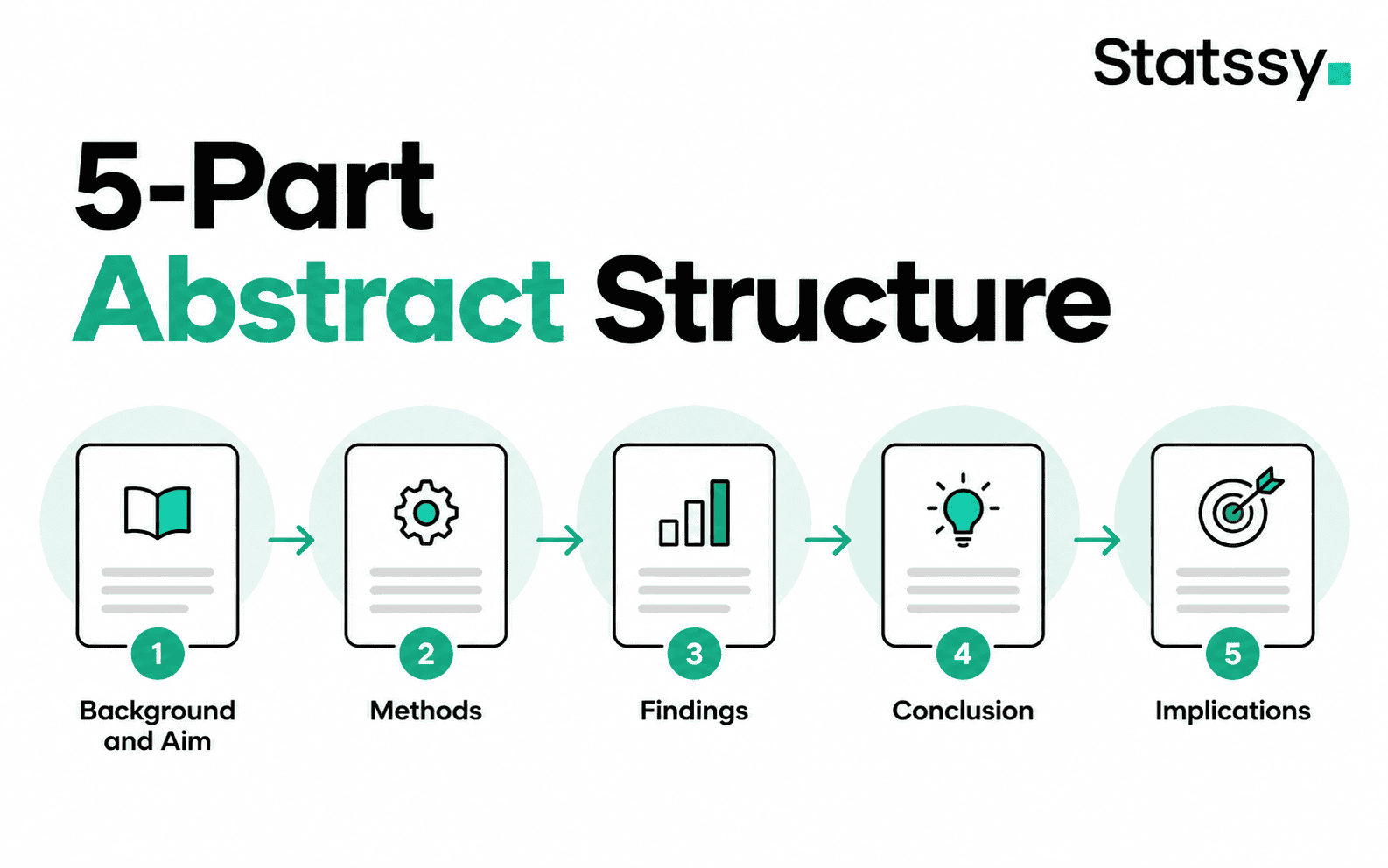
Get the order right and half the mistakes disappear. Most students go wrong in the planning, not in the writing.
- Background and aim: one sentence of context, one sentence on what you set out to find.
- Methods: design, sample, instrument and analysis.
- Findings: the real results, with direction and size.
- Conclusion: what the findings mean, within the limits of your design.
- Implications and keywords: who benefits, what should be studied next, and keywords if your university asks for them.
My rule of thumb for a 300-word abstract is about 15% for background and aim, 25% for methods, 35% for findings, 15% for conclusion and 10% for implications. Findings get the biggest share because readers look for them first.
What to Include in a Dissertation Abstract
The content of each part depends on your design.
| Part | Quantitative dissertation | Qualitative dissertation |
|---|---|---|
| Aim | Research question or hypothesis | Research question or exploratory aim |
| Method | Design, sample size, instrument, statistical test | Approach, participants, data collection, analysis method |
| Findings | Direction and size of the main result | Main themes, in plain words |
| Conclusion | Claim matched to design (association or cause) | Claim kept to this group, no generalisation |
| Implications | Practice, policy and next study | Practice, policy and transferability |
Informative, Descriptive and Structured Abstracts
A descriptive abstract tells the reader what the study covers but gives no results. An informative abstract also reports the findings. Researcher.Life describes a standalone summary of 150 to 350 words covering background, aim, methods, results and conclusions, which is the informative type. That is the type a dissertation needs.
Quantitative abstracts usually follow the IMRaD order (introduction, methods, results, discussion). Researcher.Life also notes that health-science programmes may ask for a structured abstract with headings, which are usually left out of the word count. Check whether your department wants headings or one plain paragraph.
Thesis vs Dissertation: Why UK and US Usage Differs
In the US, “dissertation” usually means a doctoral work and “thesis” a master’s. Case Western Reserve follows this, setting 350 words for dissertation abstracts and 150 for thesis abstracts. In the UK it is often the reverse: “thesis” is the PhD and “dissertation” the taught master’s or undergraduate project. Use whichever word your university uses, and read its limits under that word.
10 Dissertation Abstract Mistakes and How I Fix Each One
1. No clear aim, objectives or research question
What goes wrong: The abstract names a topic but never says what you set out to find.
Why examiners notice: Every other sentence is judged against your aim. Without it, an examiner cannot tell whether your findings answer anything.
The fix: Write one sentence starting “This study examined whether, how or what”, reworded from your Chapter 1 aim. Check that your objectives match your hypotheses, or the abstract will contradict your introduction. My guide on linking hypotheses to the study objectives shows how.
Weak → strong: “This study looks at employee motivation.” → “This study examined whether flexible working hours predict job satisfaction among nurses in England.”
2. A background that eats your word count
What goes wrong: A 250-word abstract opens with 100 words about how the world has changed.
Why examiners notice: Methods and findings get squeezed out. A California State University, Long Beach template warns that databases may cut abstracts off at about 150 words for master’s work and 350 for doctoral work. A long background can therefore hide your findings from readers who never open the full text.
The fix: Use two sentences only: one for context, one for the gap. The guide on stating the research gap clearly will help with the second.
Weak → strong: “In recent years, remote work has grown in many industries and organisations are changing.” → “Remote work has expanded quickly, but little is known about its effect on junior staff in small firms.”
3. Unclear methods
What goes wrong: “Data was collected and analysed.” It names no design, sample or test.
Why examiners notice: Without the method, they cannot judge whether your findings are credible.
The fix: Name the design, sample size, sampling approach, instrument and analysis in one sentence.
Related guides: case study vs survey research design, primary vs secondary data and the sample size calculator. For wording the method itself, see summarising research methodology.
Weak → strong: “Data was collected from participants and analysed.” → “A secondary dataset of 4,800 household records was analysed using logistic regression.”
4. No actual findings
What goes wrong: “Results are discussed in detail.”
Why examiners notice: This is a descriptive abstract sitting in an informative abstract’s slot. Examiners want the answer to your research question inside the abstract.
The fix: State the main finding for each research question, with direction and size. If nothing was significant, say so plainly, because a null result is still a finding. For wording, see reporting quantitative findings accurately and describing nonsignificant findings.
Weak → strong: “Results are discussed in detail.” → “Nurses on flexible hours reported higher job satisfaction, a medium-sized difference.”
Illustrative scenario (composite, details changed): A UK public health master’s student, whom I will call Meera, sent me a 290-word abstract with no result in it. Her supervisor had written only “too descriptive”. We cut one background sentence and added two lines on her main finding. The next round of feedback was about her discussion chapter, so the abstract had stopped being the problem.
5. Conclusions your findings do not support
What goes wrong: Correlations are reported as causes, or a convenience sample of 80 is made to speak for “all students”.
Why examiners notice: Examiners tend to check your design against your claim first. Overclaiming invites hard viva questions.
The fix: Match your verbs to your design. Use “associated with” or “predicted” for correlational data, and “caused” only for experiments. My notes on cross-sectional vs longitudinal design explain what each design allows, and the guide on defending convenience sampling shows how to word the limits.
Weak → strong: “Flexible hours improve satisfaction.” → “Flexible hours were associated with higher satisfaction in this sample of 85 nurses; the design could not test cause.”
6. New information that is not in the dissertation
What goes wrong: A number or claim appears in the abstract and nowhere else.
Why examiners notice: Examiners cross-check. Grad Coach gives the same warning: never put anything in the abstract that the main document does not present.
The fix: Highlight every abstract sentence and write the chapter and page where it appears. Any sentence without a home goes.
Weak → strong: “The study also found that manager age mattered.” (Chapter 4 never tests age.) → Delete it, or add the analysis to Chapter 4 first.
7. Ignoring the word and page limit
What goes wrong: The abstract is 470 words against a 300-word limit, or it spills onto a second page.
Why examiners notice: It looks careless, and some graduate schools return the file. Walden University lists an abstract longer than one page among common dissertation mistakes.
My view is that a page limit is a weak guide, because font size and spacing change what fits. Count words first, then check the page.
The fix: Cut background and abbreviations first, and never cut findings. Formatting slips can also cost you later, as I explain in is a poorly formatted dissertation a career problem.
Weak → strong: A 470-word abstract with a methods list and five abbreviations → a 298-word abstract with one method sentence and every abbreviation spelled out.
Illustrative scenario (composite, details changed): An engineering PhD student, whom I will call Rahul, had 470 words against a 300-word limit. He wanted to remove his results. I asked him to cut background, a methods list and three abbreviations instead, and he reached 298 words with every result intact.
8. Citations, statistics dumps, bullets and unexplained jargon
What goes wrong: The abstract carries a reference list, five p-values, a bullet list and acronyms the reader has never met.
Why examiners notice: An abstract must be readable by someone outside your sub-field. Grad Coach advises against citations in most cases, though it allows author names for seminal work, and it also advises against bullets and unexplained jargon.
The statistics question: Liberty’s Counselor Education dissertation template says to leave statistics and citations out. I partly disagree with a blanket ban on numbers, because it pushes students into vague findings, which is Mistake 4.
The fix: Where numbers are banned, describe the result in plain words, such as “a small but statistically significant difference”. Where they are allowed, give one or two key figures only. Always spell out abbreviations.
Weak → strong: “Scores rose significantly (p = .003, d = 0.41, 95% CI [0.14, 0.68], F(2, 118) = 5.9).” → “Scores rose significantly, with a small to medium effect (d = 0.41).”
9. No implications and weak keywords
What goes wrong: The abstract stops at the result and says nothing about why it matters.
Why examiners notice: Oxford Brookes expects the abstract to state the nature and scope of the work and its contribution to knowledge. UK programmes may also split this job: UCL caps the abstract at 300 words and asks for a separate impact statement of up to 500 words. So do not squeeze impact claims into the abstract itself.
The keywords conflict: Grad Coach recommends five or six keywords or short key phrases at the end. Saybrook asks you to embed keywords in the text of the abstract. Neither is wrong, so follow your own handbook and pick two to three word phrases that a stranger would actually search.
The fix: End with one sentence on who benefits and one on what should be studied next.
Weak → strong: “More research is needed.” → “Universities may add sleep guidance to first-year wellbeing support, and longitudinal studies should test the direction of the effect.”
10. Writing it first and never revising it
What goes wrong: The abstract was drafted at proposal stage and never updated, so it describes a study you no longer ran.
Why examiners notice: The abstract disagrees with your conclusion chapter.
The fix: Write it last, and rewrite it once more after your final supervisor corrections. A tidy dissertation organising guide keeps every section aligned while the draft keeps changing.
Weak → strong: “A survey of 200 employees” (written at proposal stage) → “A survey of 143 employees” (updated after data cleaning).
Not sure which of these ten your abstract has? Request an abstract review.
Dissertation Abstract Examples: Before and After
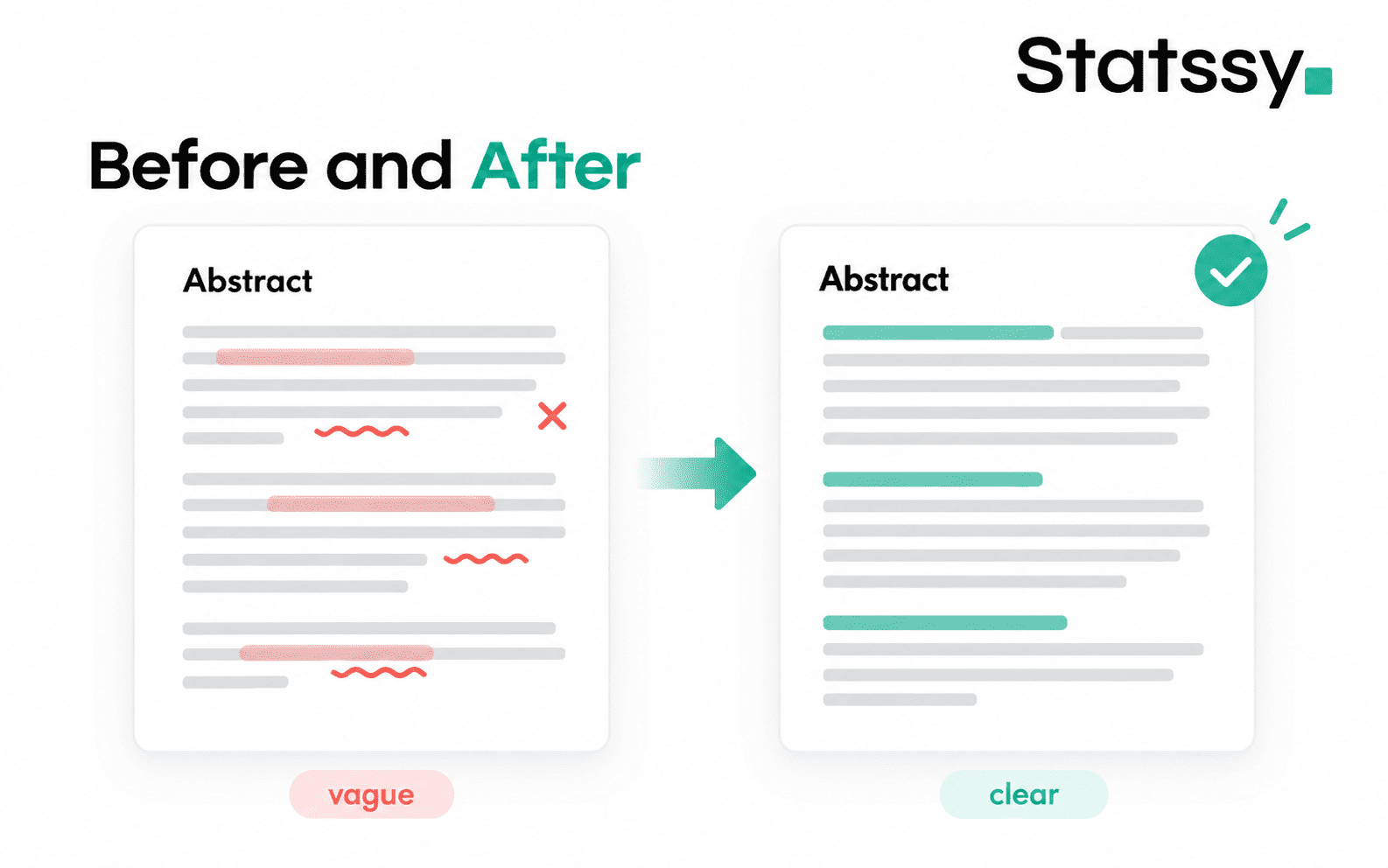
Most dissertation abstract mistakes are visible in the “before” versions below. These are illustrative examples, not real student work, and all figures are invented to show the fixes clearly.
Quantitative example: sleep and grades
Before:
Sleep is very important for students and many researchers have studied it. Universities face many challenges and student wellbeing is a big topic. This study looks at sleep and academic performance. Data was collected using questionnaires and analysed. The results are discussed in detail. The study has many implications for students and universities.
Mistakes: background too long (2), weak aim (1), vague methods (3), no findings (4), empty conclusion (9).
After (about 140 words):
This study tested whether sleep duration predicts first-year academic performance among UK undergraduates. A cross-sectional survey of 312 students at two universities measured self-reported sleep duration and collected end-of-year grade averages. Multiple linear regression controlled for age, gender and weekly study hours. The model explained 24% of the variance in grade average, and longer sleep duration was a significant positive predictor (β = 0.21, p < .001), uniquely adding about 3%. This is a small effect. Because the design was cross-sectional and sleep was self-reported, the result shows an association, not a cause. Universities may consider sleep guidance within first-year wellbeing support, and longitudinal studies should test the direction of the effect. Keywords: sleep duration; academic performance; undergraduates; multiple regression.
If your university bans statistics, replace the bracket with “a small but statistically significant positive predictor of grade average”. Behind a line like this sit assumption checks, such as multicollinearity, which my VIF guide explains.
Qualitative example: international student adjustment
Before:
This research is about international students and their experiences. Education is changing and many students now study abroad. Interviews were done and some themes were found. Students had many different experiences. More research is needed in this area.
Mistakes: no clear aim (1), generic background (2), unclear method (3), no actual findings (4), no implications (9).
After (about 120 words):
This study explored how Indian postgraduate students experience academic adjustment in UK universities. Using interpretative phenomenological analysis, semi-structured interviews were held with 12 students from three universities, and transcripts were analysed case by case before themes were compared across participants. Three themes emerged: unfamiliar expectations of critical argument, reduced confidence in classroom discussion, and peer networks as the main source of academic support. Participants described adjusting more comfortably when they received clear written feedback in their first term. The findings are not intended to be generalised, but they suggest that early guidance on critical writing and structured feedback could ease adjustment. Keywords: international students; academic adjustment; interpretative phenomenological analysis; postgraduate education.
Mixed methods in one paragraph
Saybrook extends its dissertation limit to 400 words for mixed-methods work. Give each strand one sentence on method and one on finding. Then add one sentence on how they connect, for example that the interviews explained why the survey scores differed.
What the popular example banks get wrong
I read the full Vappingo page, and its 12 sample abstracts are useful for learning the four parts. But none of the 12 “Results” lines reports an actual finding. Each describes what the study offers, which is Mistake 4 presented as a model. The labelled headings may also clash with one-paragraph rules such as Liberty’s, and the page gives no word limit.
Otio’s guide deserves credit for labelling its 24 weak, strong and improved examples as illustrative, not real studies, as I have done here. Its examples target academic papers in general, though, not dissertations with university-specific rules. Grad Coach’s five mistakes are sound, but I found no worked rewrite and no word limits on that page. That gap is why the next section exists.
Dissertation Abstract Word Count: USA vs UK Rules
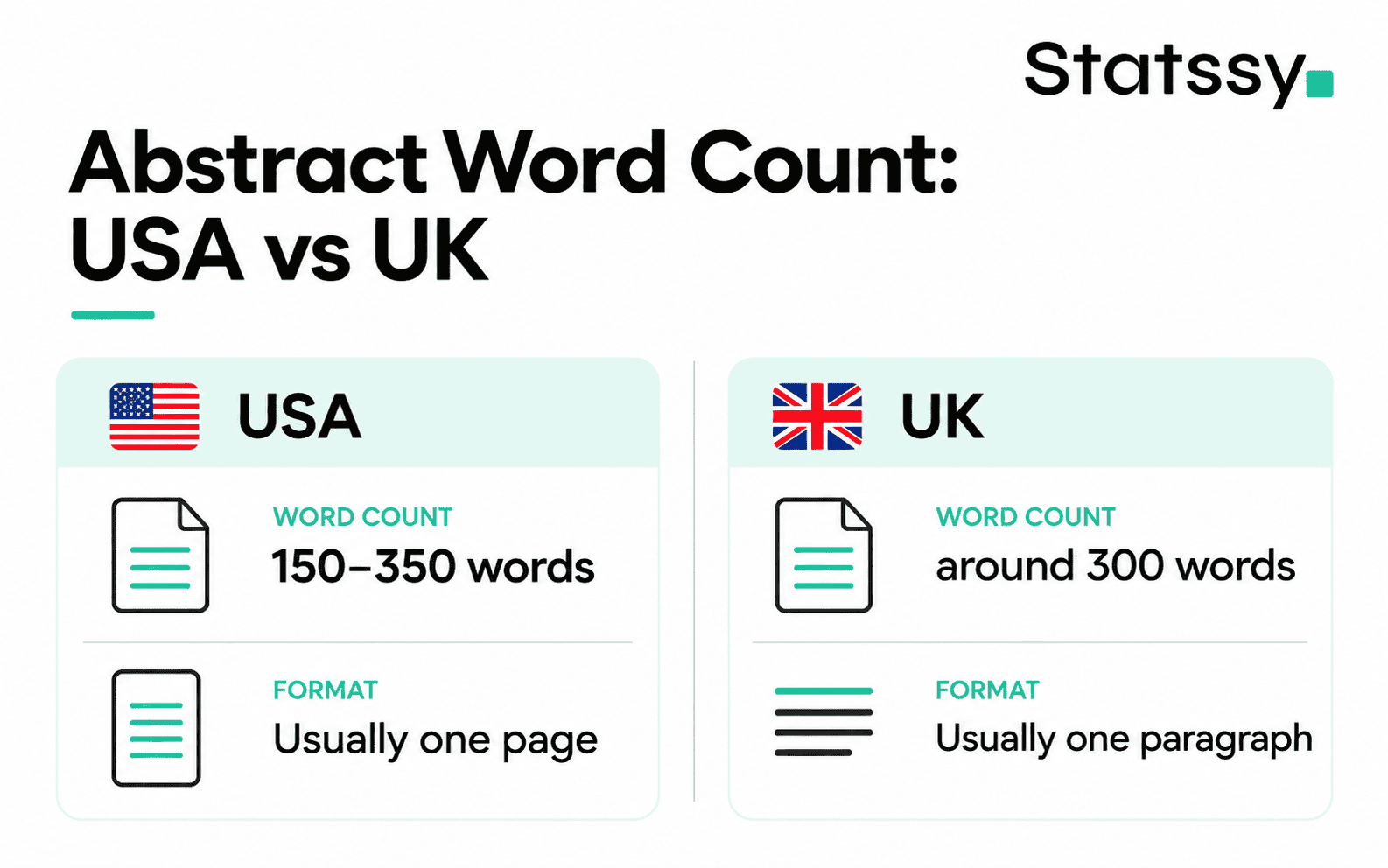
Word-limit slips are the easiest dissertation abstract mistakes to avoid, because the number is printed in your handbook. The tricky part is that each university prints a different one.
Word limits by country and level
| Where | Typical limit | Source |
|---|---|---|
| US doctoral | About 350 words | NDSU and Case Western Reserve both allow up to 350 words for dissertations. |
| US master’s | About 150 words | NDSU and Case Western Reserve both set 150 words for master’s theses. |
| US mixed methods | Up to 400 words | Saybrook extends its dissertation limit for mixed methods. |
| US (one department) | About 250 words | Liberty’s Counselor Education template recommends about 250 words or fewer on one page. |
| UK PhD | 300 words | Leicester, UEA and Newcastle all state 300 words. |
| UK (approximate) | About 300 words | Oxford Brookes says approximately 300 words. |
ProQuest truncation and why you front-load
The sources describe ProQuest differently. The CSULB template says its database record may cut master’s abstracts at about 150 words and doctoral ones at 350. The Catholic University of America’s guide says ProQuest sets no formal limit but may truncate at 350 words when preparing print editions.
My view is that the 150-word figure is a display rule, not a quality rule. Cutting your methods to hit it is a poor trade. Put your aim, method and main finding early, and keep a doctoral abstract to 350 words regardless.
Does the abstract count toward your word limit?
It depends on the university, and it can change what you cut elsewhere. UEA counts the abstract inside the thesis word count. The Open University leaves it out for PhD, MPhil and professional doctorates.
The Open University also publishes the abstract openly. It appears on Open Research Online even when the full thesis is under embargo, so keep confidential details out of it.
Format quirks to check
- One paragraph or headings? Liberty asks for one double-spaced paragraph on one page, while health programmes may want headings.
- Article-based dissertation? Case Western Reserve still requires one overall abstract, and the abstracts of individual papers can be added but cannot replace it. NDSU does not apply its word limit to abstracts of included papers.
- Full title and name: Leicester requires the full thesis title and your full name as a heading on the abstract.
- “I” or “this study”? Many science programmes prefer “this study”. APA 7 allows first person where it is clearer, but ask your supervisor.
Check your handbook in 5 minutes
- Open your graduate school’s thesis regulations or formatting guide.
- Search the file for the word “abstract”.
- Note the word limit, page limit, paragraph rule, keyword rule and any ban on citations or statistics.
- Find out whether the abstract counts toward your total word limit.
- Open two recently approved dissertations from your department. Grad Coach also suggests checking past dissertations from your programme to see the norms, and I agree because handbooks can be vague.
How to Write a Dissertation Abstract Step by Step
Writing in this order prevents most dissertation abstract mistakes.
- Write it last, after your final chapters are stable.
- Draft one sentence per element: aim, method, finding, conclusion, implication.
- Join the sentences and read them aloud as one paragraph.
- Cut by function, not by word. Remove background and adjectives first, and never remove findings.
- Cross-check every claim against your results and conclusion chapters.
- Match the handbook: word limit, paragraph format, keywords, tense and citations.
Grad Coach suggests giving two to three sentences to each chapter. The principle is sound, but the arithmetic is not. With five or six chapters, that is 10 to 18 sentences, which can cross 300 words before you reach a conclusion. A literature review earns a clause at most, and findings earn the biggest share.
What to Do After Your Abstract Is Ready
Fixing dissertation abstract mistakes is not the end of the job. Four checks come next.
- Align the chapters. Reread your conclusion chapter and introduction against the abstract. The aim, findings and limits must match in all three.
- Prepare for the viva. Some examiners use the abstract as a map, and any claim bigger than your data will be tested.
- Submit correctly. Confirm the repository or ProQuest steps, and enter the keywords exactly as the system asks.
- Think about who reads it later. Recruiters and researchers may only ever see the abstract, which is one reason employers do care about your dissertation.
Pre-Submission Checklist to Catch Dissertation Abstract Mistakes
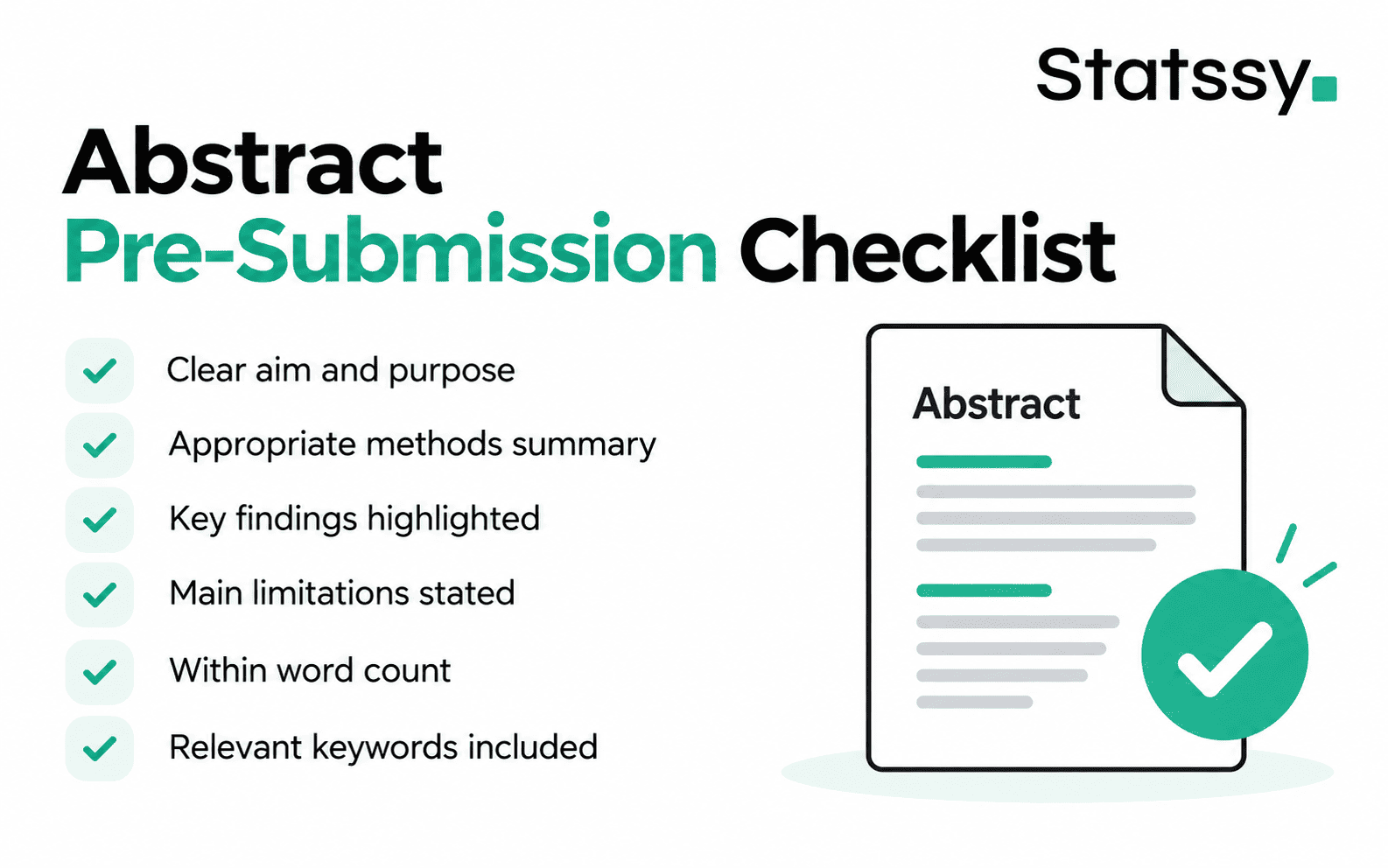
- The aim or question appears in the first two sentences.
- Methods name the design, sample and analysis.
- At least one real finding is stated, with direction and size.
- No claim goes beyond your data.
- Nothing appears that is missing from the dissertation.
- The word count meets your limit, and you know whether it counts toward your total.
- There are no citations, bullets or unexplained abbreviations, unless your handbook allows them.
- Keywords follow your handbook.
- The abstract matches your final conclusion chapter.
Get a Second Pair of Eyes Before You Submit
A fresh reader can often spot dissertation abstract mistakes quickly, which is why a second pair of eyes works. In my experience the abstract is one of the easiest sections to improve, and it is often rushed.
A 300-word abstract can look too small to pay for. But it is usually read first, and a reviewer who understands your design, quantitative or qualitative, can check it against these ten dissertation abstract mistakes in one pass. I give feedback on your own wording and never write the abstract for you.
Share your abstract and your university’s word limit, and a reviewer will mark it against the ten mistakes above and suggest fixes in plain language. If the language itself needs work, we also help with reviewing academic writing clarity. If you are unsure whether you need outside support, read how to know if you need a dissertation expert, or see how to find a dissertation writing mentor.
Generic phrasing is easy to slip into an abstract. If a supervisor has said yours sounds machine-written, read supervisor said my dissertation sounds like AI. If you have been questioned about AI use, read accused of using AI in dissertation.
FAQs on Dissertation Abstract Mistakes
How long should a dissertation abstract be?
Most UK universities cap it at 300 words, as Leicester and Newcastle do. US doctoral abstracts are commonly capped at 350 words and master’s abstracts at 150. Limits vary, so confirm yours in your handbook before trimming.
What should be included in a dissertation abstract?
Include your aim, methods, main findings, conclusion and implications. Add keywords if your university asks for them. Do not add anything that is missing from the dissertation itself.
Should I write the abstract first or last?
Last. You cannot summarise findings you have not finalised. I also recommend one more rewrite after your final supervisor corrections.
What is the difference between an abstract and an introduction?
The abstract summarises the entire study, including findings, in a few hundred words. The introduction sits in the body, sets up the problem and does not report results.
Can I include statistics and citations in my abstract?
Citations are usually avoided. Statistics depend on your university, and Liberty’s Counselor Education template says to leave them out. If banned, describe the result in plain words, such as “a small but significant difference”.
Does the abstract count in my dissertation word count?
It depends. UEA includes the abstract in the thesis word count, while the Open University excludes it for PhD and MPhil theses. Check your own regulations.
Should an abstract be one paragraph, and in which tense?
Usually one paragraph, unless your programme wants headings. Use past tense for what you did and found, and present tense for implications. Follow your handbook if it says otherwise.
How many keywords should I include?
Grad Coach suggests five or six keywords or short phrases. Saybrook asks for keywords to be embedded in the text. Follow your handbook, and use two to three word phrases people would actually search.
Can I use “I” in a dissertation abstract?
Sometimes. Many science programmes prefer “this study”, and APA 7 allows first person where it is clearer. Qualitative programmes often accept it. Ask your supervisor and check recent approved dissertations.
About the author: Siddharth Gupta is an independent analyst and dissertation expert with 12 years of experience guiding students through research design, analysis and writing.