
15 Common Literature Review Mistakes and How to Correct Them
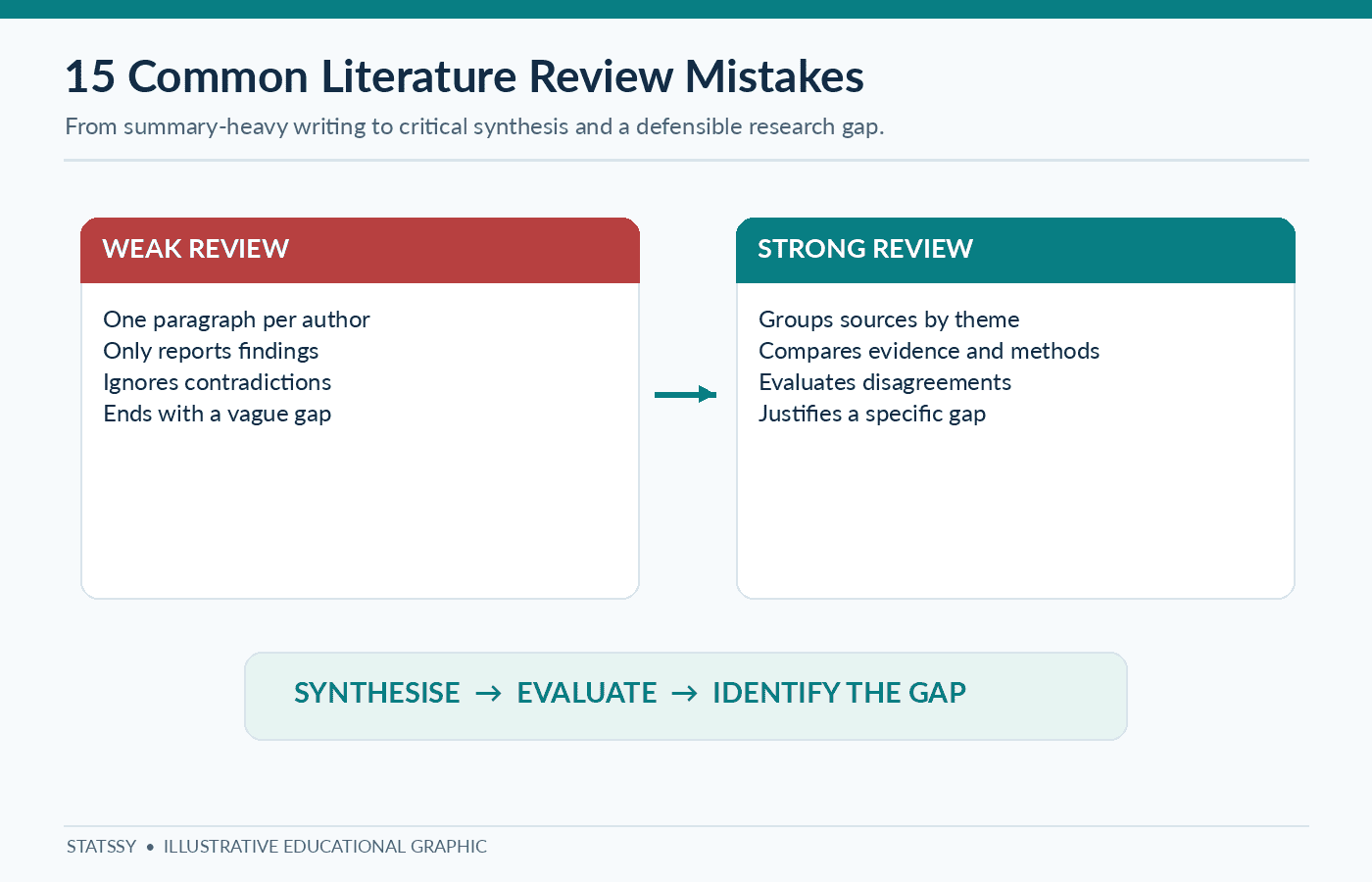
Literature review mistakes are the single biggest reason a strong dissertation chapter comes back marked “needs revision.” I have read thousands of literature review drafts over the past 12 years, and the same literature review mistakes show up again and again, in every discipline, at every university, from first-year masters students to PhD candidates on their third supervisor meeting.
None of these mistakes mean the student did bad research. Usually the research is fine. The writing just never turned that research into an argument.
When people search for common mistakes in literature review writing, most lists stop at citation errors and outdated sources, which misses where the real damage happens. That is what this article fixes, mistake by mistake, with real before and after examples.
What is a literature review mistake?
A literature review mistake is any error in how existing research is selected, organised, or written up that stops the review from building a clear, evidence-based argument toward a research gap. The most common ones are summarising instead of synthesising, weak thematic organisation, outdated sources, and a missing or vague research gap.
Here are all 15 literature review mistakes at a glance, each explained in full with a fix further down.
- Summarising studies without synthesis
- Using outdated or irrelevant sources
- Over-relying on secondary sources instead of primary studies
- Weak thematic organisation
- No logical flow or transitions between themes
- Confusing a literature review with an annotated bibliography
- Staying purely descriptive instead of critical
- Citing only sources that agree with you
- Missing your own authorial voice
- Treating every source as equally credible
- Failing to establish a convincing research gap
- Including off-topic or irrelevant content
- Drafting before reading is complete
- Inconsistent or incorrect citation formatting
- Letting AI tools summarise instead of you synthesising
What Makes a Literature Review Weak in the First Place
Before the 15 mistakes, it helps to understand the one thing that separates a strong literature review from a weak one. It is not the number of sources. It is not even the quality of the writing style. It is whether the review builds an argument or just reports one study after another.
Most study-skills guides treat literature review mistakes as a formatting problem, something a citation manager or a stricter word count fixes. I disagree. In 12 years of correcting these drafts, the real problem almost always starts upstream, in how source material gets read and grouped, long before anyone opens a style guide.
I ask every student I work with the same question before we even open their document. “If I deleted the author names and dates, would this still make sense as an argument?” If the answer is no, the review is probably descriptive, not critical, and that is mistake number one on this list.
Descriptive vs Critical Literature Review, the Real Difference
A descriptive literature review reports what each study found, one after another, usually in the order the student read them. A critical literature review groups studies by theme, compares what they found, points out where they disagree, and uses that comparison to argue for something, usually the gap the student’s own research will fill. a university’s guide to writing a critical literature review defines the difference this way, as comparing and evaluating rather than reporting, but in my experience the definition alone rarely changes how a student actually writes. What changes it is seeing the verb-level difference in practice, which is why I built the cheat sheet further down in this article.
The difference is not academic jargon. A descriptive review reads like a book report. A critical review reads like a case being built in a courtroom.
Why These Mistakes Keep Showing Up Even With Good Research
Most students I work with have read the right papers. The problem is almost never the reading list. It is that nobody ever showed them how to turn forty separate summaries into one connected argument, so they default to the only structure they know, which is one paragraph per paper.
That is a writing problem, not a research problem, and writing problems are fixable in a weekend once you see the pattern. This upstream cause is exactly why the same literature review mistakes keep reappearing even in drafts built on genuinely good research.
Source and Reading Literature Review Mistakes
The first group of literature review mistakes happens before a single word is written, often while still searching Google Scholar or Scopus for sources, at the reading and selection stage rather than the writing stage.
Mistake 1. Summarising Studies Without Synthesis
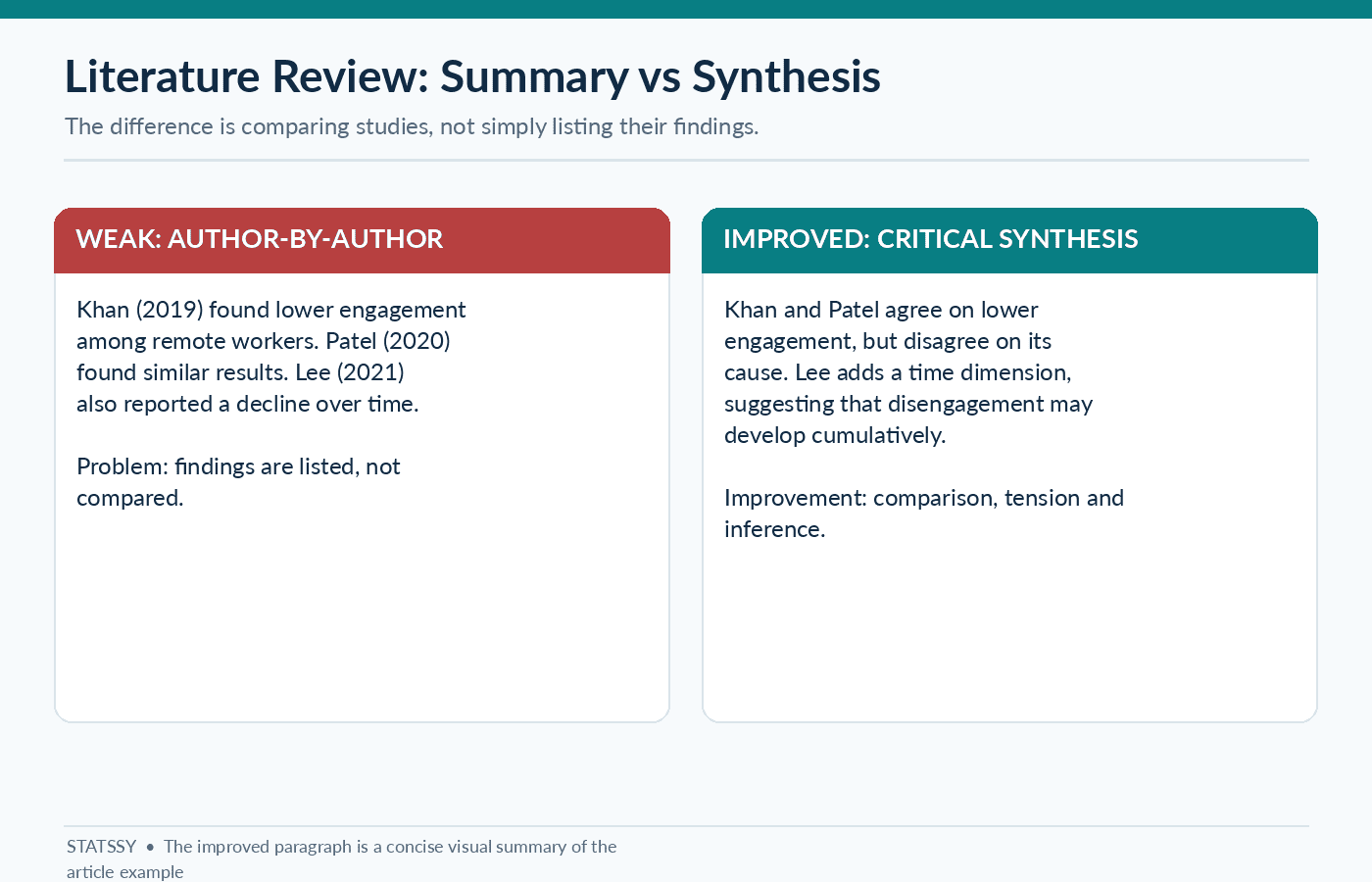
This is the most common of all literature review mistakes, and it is the one I correct most often. The student reads twenty papers, writes one paragraph per paper, and stacks them under a theme heading.
Nothing connects them. Nothing compares them. The reader finishes the section knowing twenty facts and zero arguments.
Weak paragraph “Khan (2019) found that remote employees reported lower engagement scores. Patel (2020) studied engagement in hybrid teams and found similar results. Lee (2021) also researched remote work and engagement, finding a decline over time.”
That weak paragraph above is exactly the kind of poor literature review examples I see on a weekly basis, and it is also the easiest of all 15 mistakes to fix once a student sees the pattern.
Improved paragraph “Engagement research on remote work is consistent on direction but split on cause. Khan (2019) and Patel (2020) both report lower engagement scores in remote and hybrid settings, but Khan attributes this to reduced informal communication, while Patel links it to unclear performance expectations. Lee (2021) complicates both explanations by showing the decline is not immediate but builds over eighteen months, which suggests the mechanism is cumulative rather than structural.”
Notice the improved version never adds new research. It just compares the three studies against each other instead of listing them. That single shift from listing to comparing is what synthesis actually means.
This is a pattern I see often. One client, a public health masters student, had this exact problem across her entire thirty-page chapter. We did not add a single new source, we just regrouped her existing papers into comparison clusters by theme, and her supervisor’s next round of feedback shrank from a full page of comments to just a few lines.
Mistake 2. Using Outdated or Irrelevant Sources
Citing a 2003 study as your primary evidence in a 2026 dissertation on social media behaviour is a credibility problem, not just a style one. Fields move at different speeds. Classical theory in sociology can be decades old and still be the right citation, what researchers call a seminal work. Anything in AI, digital platforms, or consumer behaviour older than five to seven years needs a very good reason to still be your main evidence.
The fix is simple. For every source older than ten years, ask whether it is a seminal work or just an old fact. A seminal work stays. An old fact gets replaced or cut entirely. Stale sourcing is a quiet one among all the literature review mistakes on this list, the kind that goes unflagged until an examiner checks your reference list by hand.
Mistake 3. Over-Relying on Secondary Sources Instead of Primary Studies
Citing a textbook that summarises a study, instead of citing the original study, is a shortcut examiners notice fast. It also means you are trusting someone else’s interpretation of the data instead of forming your own, which is the entire point of a literature review. If you decide your dissertation will lean on secondary data for its own analysis chapter, that is a separate and legitimate design choice. This guide on choosing between primary and secondary data walks through when that decision makes sense.
In your literature review specifically, track down the original study whenever you can. A database search through Google Scholar or your library’s Scopus access usually turns up the original in five minutes, not five hours, and it quietly avoids one of the more common literature review mistakes examiners catch during a reference check.
Structure and Organisation Mistakes
This is where I see the most literature review mistakes linked to poor organising, and it is also where most generic writing advice gives the least useful fix, telling students to simply “organise by theme” without ever showing what that looks like on the page.
Mistake 4. Weak Thematic Organisation
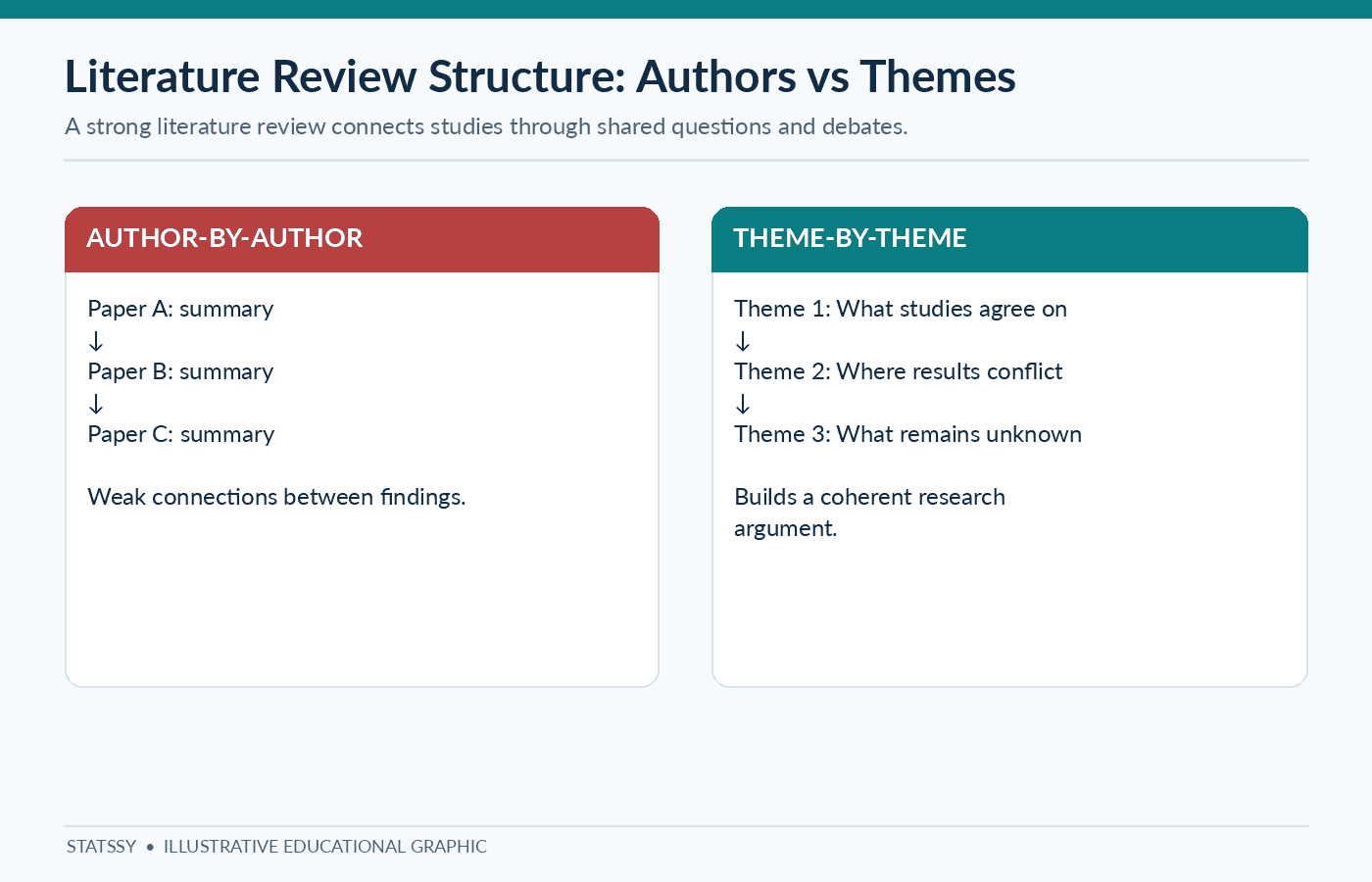
Organising a literature review by author, by publication date, or by database search order is the second most common mistake I see. The reader cannot follow an argument that is ordered by when the writer happened to read each paper. A literature review needs to be organised by theme, by variable, or by debate, never by chronology of your own reading process, and this grouping decision is effectively the outline for the rest of the chapter, even though almost nobody calls it that at this stage.
If you are unsure where to start, this guide to organising a dissertation chapter breaks down a practical process for grouping material before you draft a single sentence. [Internal link suggestion – an article on structuring a quantitative literature review specifically]
Mistake 5. No Logical Flow or Transitions Between Themes
Even a well organised review falls apart without transitions that tell the reader why theme two follows theme one. A one-line bridge sentence at the start of each new section, explaining the connection to what came before, is often all that is missing. It is a small fix for one of the more overlooked literature review mistakes on this list.
Mistake 6. Confusing a Literature Review With an Annotated Bibliography
An annotated bibliography lists sources separately, each with its own short note. A literature review integrates sources into paragraphs organised around a theme, where several sources appear in the same sentence because they are being compared. If every paragraph in your chapter starts with an author’s name, you are likely writing an annotated bibliography with extra words, not a literature review. This is one of the literature review mistakes that comes from confusing two assignment types, not from weak writing itself.
Critical Thinking and Voice Mistakes
These literature review mistakes are about how you think on the page, not what you cite, and they are the hardest group to self-correct because a student rarely sees their own blind spot.
Mistake 7. Staying Purely Descriptive Instead of Critical
This deserves its own full example, because it is the mistake examiners flag most often in feedback, even when they do not use the word “descriptive” to describe it.
Weak paragraph “Several studies have examined burnout among nurses. Smith (2018) surveyed 200 nurses and found high burnout rates. Johnson (2019) interviewed nurses and reported similar findings. Garcia (2020) also confirmed burnout is common in nursing.”
Improved paragraph “The burnout literature in nursing is extensive but methodologically narrow. Smith (2018) and Johnson (2019) both rely on self-reported burnout scales, which Garcia (2020) argues inflate prevalence because nurses under organisational pressure may over-report distress to justify requesting support. This methodological tension, unresolved across a decade of research, is precisely the gap this study addresses by using objective physiological stress markers alongside self-report data.”
The improved version does three things the weak one does not. It compares, it evaluates methodology, and it connects directly to the writer’s own research gap.
Mistake 8. Citing Only Sources That Agree With You
Confirmation bias is easy to fall into when you already have a hypothesis before you finish reading. A literature review that cites only supporting evidence looks thin to any examiner who knows the field, because they know the contradicting studies exist even if you left them out. Including and honestly addressing the studies that complicate your argument is what makes the review credible, not weaker. Of all 15 literature review mistakes on this list, this is the one that damages credibility most quietly, since the student rarely notices it in their own draft.
Mistake 9. Missing Your Own Authorial Voice
A review built entirely from other people’s findings, with no sentence that says what you think it means, reads as safe but forgettable. Phrases like “this suggests,” “this is significant because,” or “what these studies do not explain is” are where your voice belongs, and examiners are specifically trained to look for them. This is a quieter entry on the literature review mistakes list than the others, and supervisors rarely name it directly even when it is exactly what they mean.
Mistake 10. Treating Every Source as Equally Credible
A peer reviewed longitudinal study indexed on Web of Science and a single blog post making a similar claim are not equal evidence, but many drafts cite them with the same confidence. Part of building credible evidence is checking that every citation is what it claims to be, especially if any of your research summarising was assisted by AI tools, where verifying AI-generated citations before submission has become a genuinely necessary step.
Gap, Scope and Technical Mistakes
The last five literature review mistakes are about scope control and the technical discipline of finishing the chapter properly, and this is the cluster where I see the most avoidable marks lost for work that was otherwise strong.
Mistake 11. Failing to Establish a Convincing Research Gap
A literature review without a clearly stated gap is just a summary of the field with no reason to exist. The gap has to be specific, not “more research is needed,” but precisely what has not been studied, why it matters, and how your research addresses it. A vague ending like this is one of the most expensive literature review mistakes, because it undoes credibility built over dozens of pages in the final paragraph. [Internal link suggestion – an article on identifying a defensible research gap]
I have seen this cost a candidate a proposal more than once. One PhD candidate’s review was thorough, well over fifty sources, but ended with “further research is recommended in this area,” which tells an examiner nothing. We rewrote the final two paragraphs to name the specific methodological gap those sources collectively left open, and the proposal cleared review on the next attempt.
Mistake 12. Including Off-Topic or Irrelevant Content
More sources is not automatically a stronger chapter. A review with thirty tightly relevant sources beats one with sixty sources where half are loosely connected padding. Every paragraph should earn its place by directly supporting the argument toward your gap. Padding a chapter to hit a word count is a literature review mistake that works against itself, since it is also the fastest way to dilute an otherwise strong argument. [Internal link suggestion – an article on connecting literature to a theoretical framework before moving into hypotheses]
Mistake 13. Drafting Before Reading Is Complete
Starting to write after reading only ten or fifteen sources, hoping the rest will slot in later, almost always produces a review that has to be restructured from scratch once the remaining sources surface a theme nobody planned for. Finish the reading and build your theme map first. The draft goes faster once you do, not slower.
Mistake 14. Inconsistent or Incorrect Citation Formatting
This is the most mechanical of all 15 literature review mistakes, and also the fastest to fix. Mixed citation styles, missing page numbers for direct quotes, and reference list entries that do not match in-text citations are an easy, avoidable way to lose marks on a chapter that is otherwise strong. Build your reference list as you write rather than fixing it in one pass at the end.
Mistake 15. Letting AI Tools Summarise Instead of You Synthesising
This is the newest entry on this list, and I expect it to climb higher every year. AI tools are genuinely useful for finding sources and drafting a first-pass summary, but a summary generated by a tool and pasted in with light editing is still a summary, not synthesis, and examiners are getting noticeably better at spotting the pattern. If you have had a supervisor question AI involvement in your writing, this guide on being accused of using AI in a dissertation covers how to respond and how to prevent it happening again. [Internal link suggestion – an article on disclosing AI assistance transparently in academic writing]
Use AI to speed up the reading and organising stage. Do the comparing, evaluating, and gap-building yourself. That division of labour is what keeps a literature review defensible, and it is the one literature review mistake I expect to keep getting worse before it gets better.
How to Organise Literature Review Themes
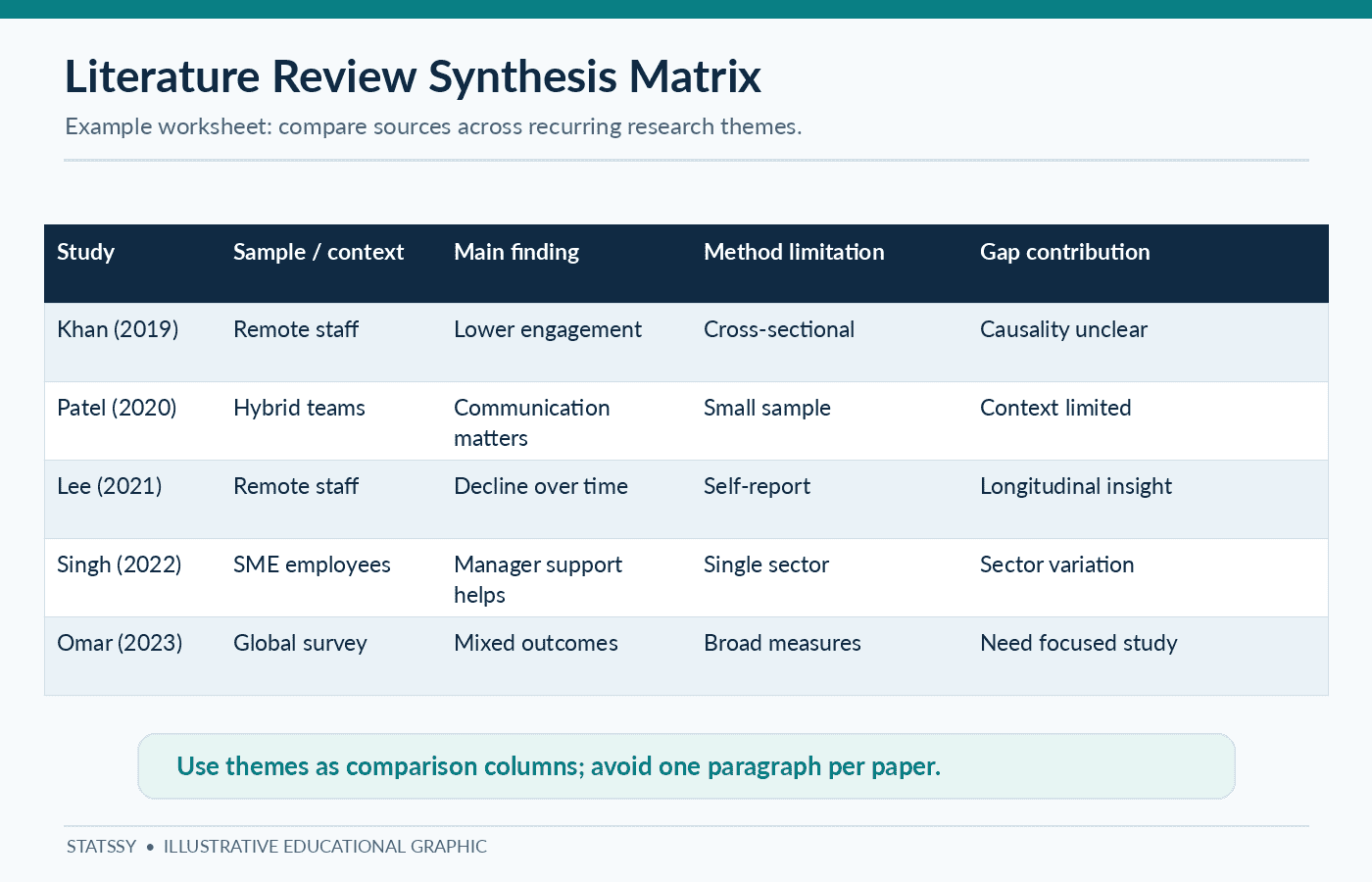
Here is the exact process I walk students through, step by step, once their reading is done and before they write a single paragraph.
- List every source on one page, with the full citation and a one-line note on its main finding.
- Build a synthesis matrix. a university library’s synthesis matrix guide puts sources down the rows and recurring themes across the columns, then marks where each source contributes to each theme.
- Group sources into theme buckets. A single source can sit in more than one bucket, and some buckets will have only two or three sources, which is normal.
- Order the buckets logically, usually from broad context toward the specific angle your research narrows into.
- Write one comparison paragraph per bucket, not one paragraph per source inside it.
- End each bucket by stating what it does not yet explain, which becomes the raw material for your gap statement later.
This matrix approach is also the fastest way to catch weak thematic organisation before your supervisor does, because any bucket with only one source, or any source that does not fit a bucket at all, becomes obvious immediately.
Descriptive vs Critical Literature Review, the Language That Makes the Difference
The gap between descriptive and critical writing often comes down to verb choice.
Reporting verbs (keep these for background context only) – found, showed, reported, stated, noted, observed.
Evaluative verbs (use these to build your argument) – argues, challenges, overlooks, assumes, contradicts, extends, complicates, undermines.
Swap even a third of your reporting verbs for evaluative ones and the entire tone of a paragraph shifts from descriptive to critical, without adding a single new fact.
How to Improve a Dissertation Literature Review Before You Submit
Run your draft against this checklist before you send it to your supervisor.
- Does every section compare sources instead of listing them one by one.
- Is the structure organised by theme, not by author or publication date.
- Does each paragraph include at least one evaluative verb.
- Have you included sources that complicate or disagree with your argument.
- Does the review end with a specific, defensible research gap, not a vague call for more research.
- Are your oldest non-foundational sources within the last seven to ten years.
- Does your own voice appear at least once per section.
- If AI tools were used anywhere in the process, has every citation been independently verified.
- Does the literature you have reviewed actually justify the methodology you go on to use. [Internal link suggestion – an article on connecting the literature review to research methodology]
Most of these literature review mistakes are fixable in a single focused weekend once this checklist flags them.
When to Get a Second Pair of Expert Eyes
Some drafts, especially ones that have been rewritten four or five times under deadline pressure, benefit from an outside read that is not the student’s own eyes going over familiar sentences for the tenth time. If you keep getting the same vague feedback from your supervisor without a clear fix, finding a dissertation mentor for a focused review session is often faster than another solo rewrite. If you are not sure your draft even needs outside help, this guide on knowing when you need a dissertation expert answers that faster than guessing. [Internal link suggestion – an article on deciding when to seek dissertation guidance more broadly]
FAQ
What are the most common mistakes in a literature review?
The most common literature review mistakes are summarising sources instead of synthesising them, organising by author or date instead of theme, relying on outdated sources, and ending without a clear, specific research gap.
What is the difference between a descriptive and a critical literature review?
A descriptive literature review reports what each study found, one after another. A critical literature review compares studies against each other, evaluates their quality, and uses that comparison to build an argument toward a research gap.
How many sources should a literature review have?
Most master’s chapters use thirty to sixty closely relevant sources, and PhD reviews often run higher. There is no single fixed number, but a smaller set of tightly relevant sources always outperforms a larger set padded with loosely connected ones.
How do you organise a literature review by theme?
Build a synthesis matrix with sources as rows and recurring themes as columns, group sources into theme buckets based on where they overlap, then write one comparison paragraph per bucket instead of one paragraph per source.
How long should a literature review be?
A standalone literature review section typically runs a few thousand words, while a full dissertation chapter runs considerably longer. Exact length depends on your institution and degree level, so write enough to cover the key literature thoroughly and build a convincing gap, rather than aiming at a specific word count.
What is a research gap and why does my literature review need one?
A research gap is the specific, unanswered question your own study will address, built from what the literature you reviewed has not yet resolved. Without it, a literature review reads as a summary of the field with no reason for your research to exist.
Can a literature review be too descriptive?
Yes, and it is one of the most common literature review mistakes examiners flag. A review that only reports findings study by study, without comparing or evaluating them, reads as descriptive regardless of how many sources it cites or how well it is formatted.
How do you synthesise sources instead of summarising them?
Summarising restates what each study found, one at a time. Synthesising compares two or more studies in the same paragraph, points out where they agree or disagree, and explains what that agreement or disagreement means for your own research gap.
Do I need a specific citation format like APA for my literature review?
Follow whatever citation format your department requires, most commonly APA Style, and apply it with total consistency from the first citation to the last. APA Style’s own site is the most reliable reference when a specific formatting question comes up mid-draft.
What is the difference between a literature review and a systematic review?
A standard literature review is a narrative synthesis built around themes and arguments, written with the author’s own critical voice throughout. A systematic review follows a predefined, documented search and inclusion protocol so another researcher could repeat it exactly, which is a methodological commitment most dissertation literature reviews are not expected to make.
Siddharth Gupta has spent 12 years guiding dissertation and thesis students through research design, literature review structure, and statistical analysis. Connect on LinkedIn.