
12 Common Dissertation Proposal Mistakes That Lead to Rejection
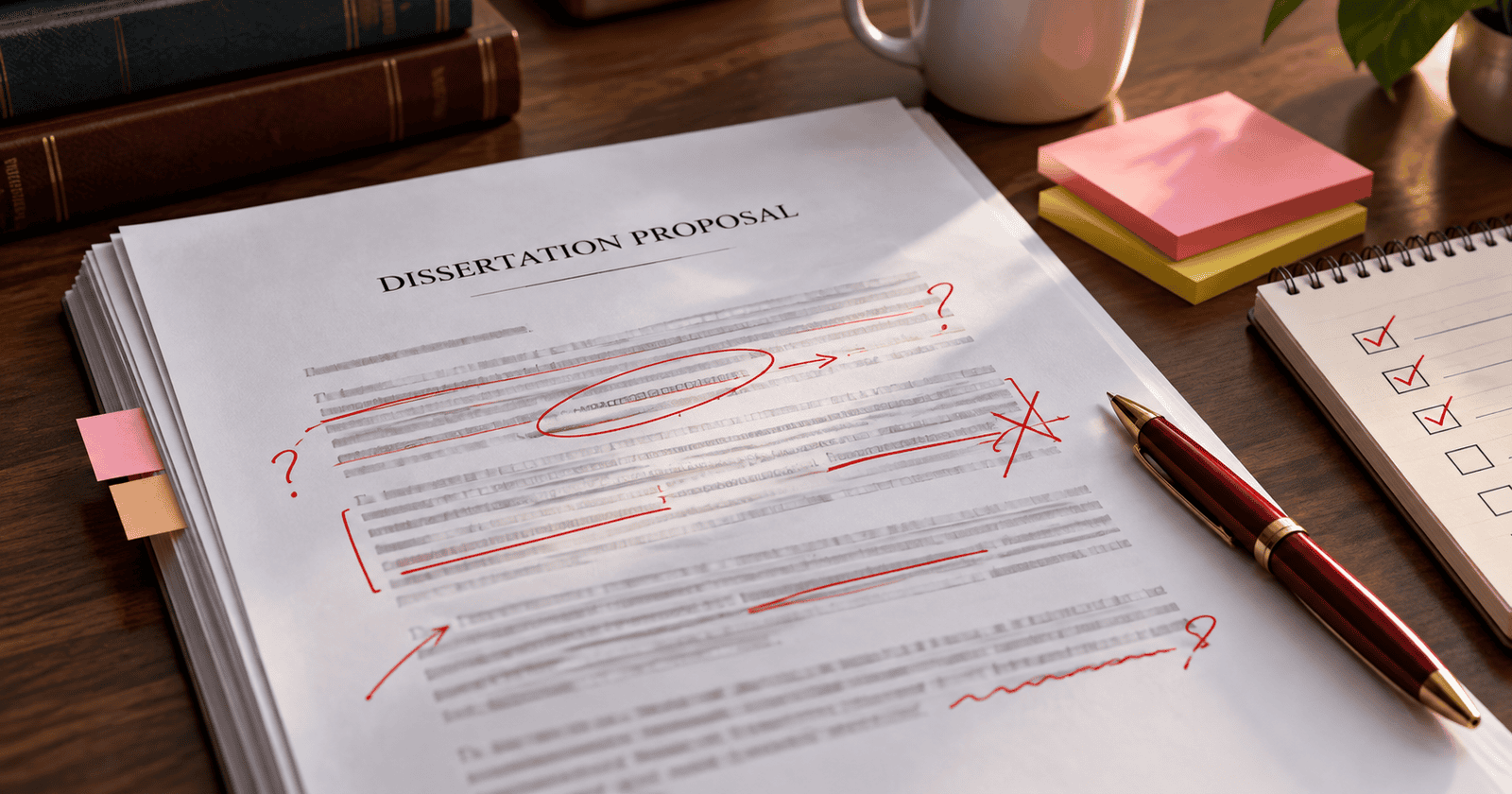
Dissertation proposal mistakes are the single biggest reason a well-researched idea gets sent back instead of approved. I have reviewed and fixed proposals for over a decade, and in almost every rejected draft I’ve looked at, the research itself was not the actual problem. The proposal simply failed to show the research clearly enough for a supervisor to say yes. This guide walks through the 12 mistakes I see most often, with real examples of what a weak version looks like and exactly how to fix it.
The Real Reasons Dissertation Proposals Get Rejected
A dissertation proposal is a short planning document, usually between 1500 and 3000 words, that explains what you intend to research, why it matters, and how you plan to carry it out. It is submitted to a supervisor or committee for approval before you start formal data collection. Reasons dissertation proposals get rejected almost always trace back to one of three things, an unclear idea, an unrealistic plan, or writing that fails to convince the reader you know what you are doing.
Most students assume rejection means the topic was bad. In my experience, that is rarely true. The topic is usually fine. What is missing is proof, on paper, that you have thought it through.
The 12 Most Common Dissertation Proposal Mistakes
These are the most common mistakes in research proposals that I flag when a client brings me a draft that was sent back for revision. For each one, I’ve included what the weak version typically looks like and what I change it to.
1. Weak or Unfocused Research Question
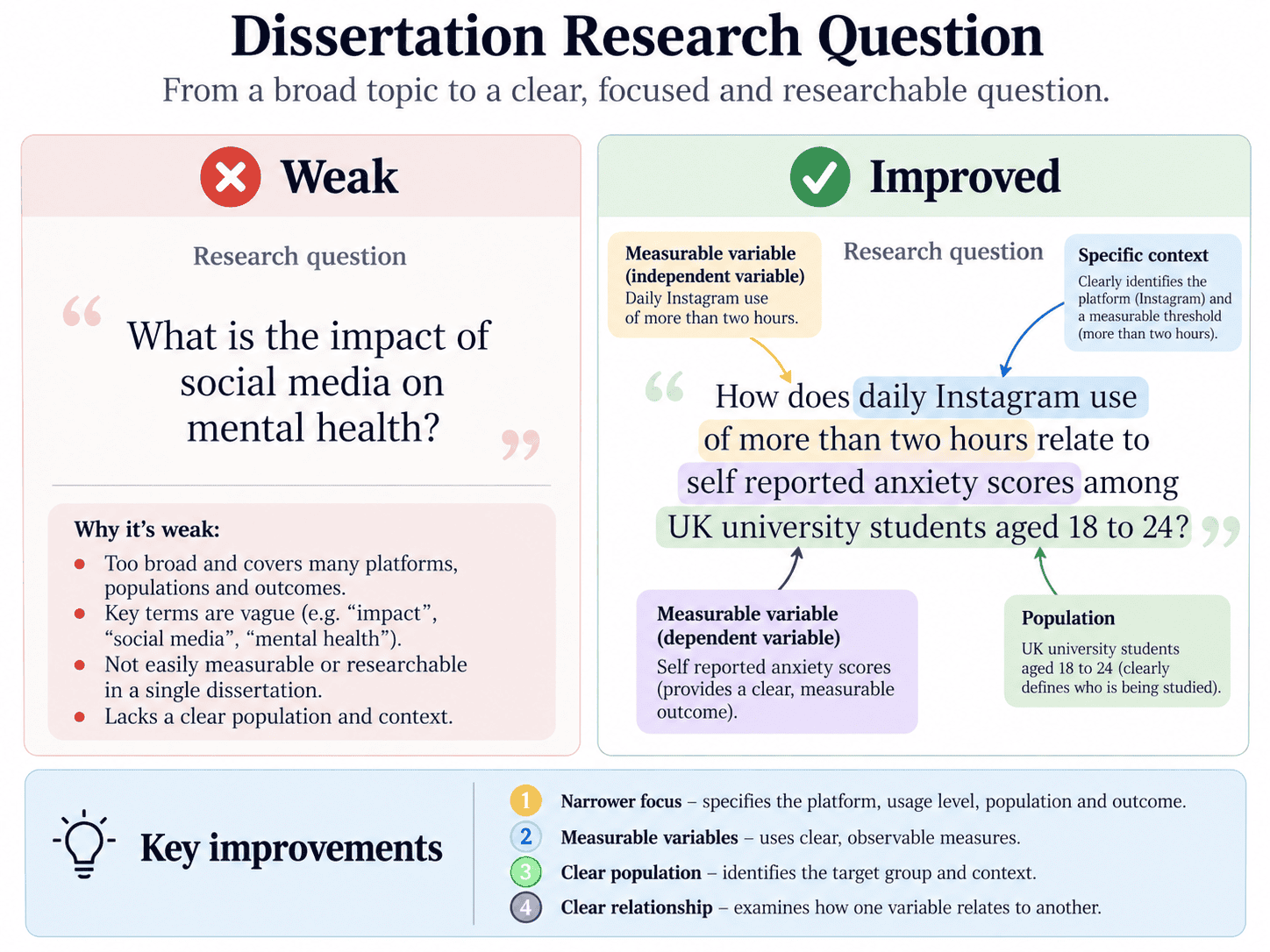
A vague research question is one of the most common dissertation proposal mistakes, and the fastest way to get rejected. If your supervisor cannot tell exactly what you are measuring or comparing, they cannot judge whether your project is doable in the time you have.
Weak – “What is the impact of social media on mental health?”
Fix – “How does daily Instagram use of more than two hours relate to self reported anxiety scores among UK university students aged 18 to 24?”
The fix adds a population, a measurable variable and a clear relationship. That is what a reviewer is actually checking for, not how interesting the topic sounds.
Before you finalise any research question, test it against the FINER criteria, feasible, interesting, novel, ethical and relevant. A question that fails even one of these rarely survives committee review untouched.
2. Unclear or Missing Research Gap
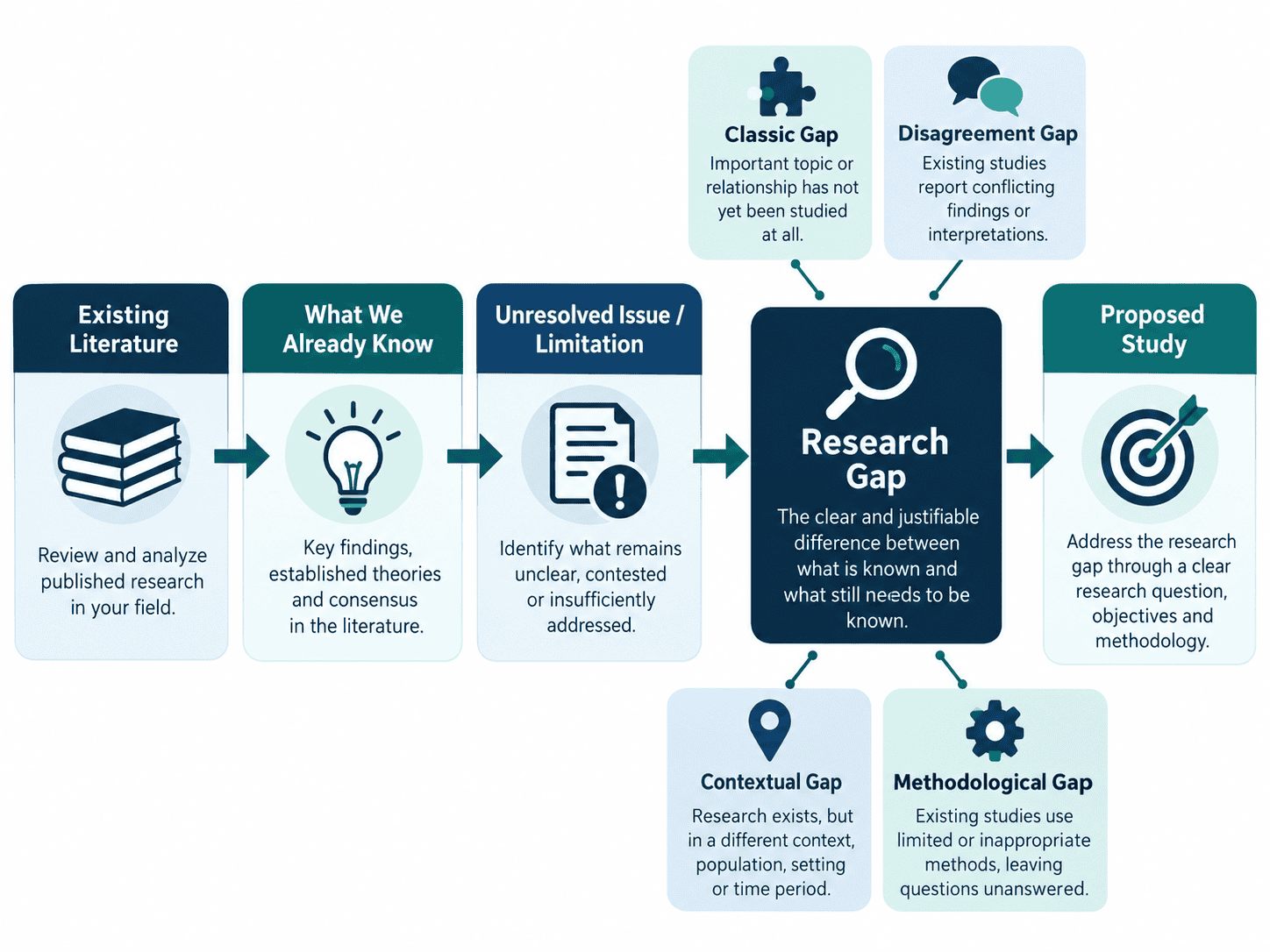
Every proposal needs to answer one question honestly, why does this study need to exist. Students often write “no research has looked at this exact combination” and treat that as a gap statement, sometimes called a problem statement. On its own, it is not enough.
There are four recognised types of research gap, and naming which one you are filling makes your case far stronger than a vague “nobody has done this” claim.
- Classic gap – no one has studied the topic at all.
- Disagreement gap – existing studies contradict each other.
- Contextual gap – the topic is studied, but not in your setting or population.
- Methodological gap – prior studies used weak or outdated methods.
Indiana University’s library guide on identifying a research gap is a good place to pressure-test which type you are actually arguing.
Weak – “No prior research has looked at this exact combination.”
Fix – “Despite extensive research on remote work productivity, almost none of it examines small manufacturing firms in Tier 2 Indian cities, where infrastructure constraints change the picture entirely.”
I once reviewed a proposal from a student studying employee burnout. Her literature review was genuinely strong, but she never stated the gap directly. Her supervisor read it twice and still wrote back asking what was actually missing from the literature. One added paragraph fixed it.
3. Unrealistic or Vague Research Objectives
Objectives are where ambition quietly turns into a problem. I regularly see five or six objectives crammed into a proposal that only has the time and budget for two. Most generic advice just says to “keep your objectives realistic,” which is true and not very useful, because nobody thinks their own objectives are unrealistic until someone else counts them.
Weak – Objectives spanning policy recommendations, organisational culture change, training redesign and a new measurement framework, all in one dissertation.
Fix – Two to three objectives that map directly back to the research question, nothing more.
If an objective cannot be traced back to your research question in one sentence, cut it.
4. Inappropriate Methodology With No Theoretical Justification
A lot of students pick a method because it feels familiar, not because it actually answers the research question. Interviews get chosen because they sound manageable. Surveys get chosen because a template exists online.
If your question asks “how much” or “how strongly related,” you need a method built for measurement and generalisation, not one built for depth and meaning. Deciding between a cross-sectional and longitudinal design early avoids a mismatch your supervisor will catch immediately. This is also where your theoretical framework belongs, the established theory or model that justifies why this method should work for this question, not just a method you happened to find comfortable.
Fix – State explicitly, in one paragraph, why this method and not the obvious alternative, tied directly to what your research question needs.
5. Thin or Outdated Literature Review
A literature review that only summarises papers one after another, without connecting them, reads like an annotated bibliography. Supervisors notice this immediately, and it signals you have not actually engaged with the debate in your field. Most generic advice just tells you to “read more sources,” but volume was never the actual problem, synthesis is.
I also see literature reviews leaning almost entirely on sources from ten or fifteen years ago, in fields that move fast. That weakens your contextual gap claim before you’ve even made it.
Fix – Organise the review by theme or by point of disagreement between authors, not paper by paper in the order you found them.
6. Topic Too Broad or Not Feasible in the Time Available
“The impact of AI on global education” sounds impressive and is completely unworkable for a master’s dissertation. Rejected proposals usually try to study everything at once.
Weak – A topic with no geographic, time or population boundary.
Fix – Narrow the geography, the sample and the timeframe to something one person can realistically complete, then state that scope explicitly in the proposal.
7. Sample Size and Statistical Power Not Justified
Quantitative proposals that state a sample size with no justification behind it are an easy rejection. A number pulled out of thin air tells the reviewer you have not planned your statistics yet.
Before you commit to a number, run it through a sample size calculator and state your assumptions, expected effect size, confidence level and power, directly in the proposal.
If access, not random selection, is actually driving your sample, say so and defend why a convenience sample is still acceptable for your design rather than presenting it as a random draw it never was.
Fix – Replace “a sample of 100 participants will be used” with the actual calculation and the assumptions behind it.
8. Plagiarism and Weak Citation Practice
This mistake has got more serious since AI writing tools became common. Supervisors now routinely run proposals through similarity and AI detection software, and an over-paraphrased or AI-smoothed paragraph can read as suspicious even when the underlying work is genuinely your own.
If you have used an AI tool anywhere in your drafting process, know exactly what your university allows before you submit. Here is what to do if you get accused of using AI in your dissertation, because the right response is very different depending on whether the flag is accurate.
Fix – Cite properly at the idea level, not just for direct quotes, and keep your drafts and notes as evidence of your own process.
9. Ignoring Ethics and IRB or Institutional Approval Requirements
If your proposal involves collecting data from real people, especially a vulnerable or protected group, and you have not addressed consent, data handling and anonymity, your proposal stops right there, regardless of how good everything else is. US federal guidance on IRB procedures is a useful baseline even outside the US, since most university ethics boards mirror the same core requirements.
A client of mine had a strong proposal on classroom anxiety in minors rejected outright on the first page of review, purely because the ethics section was two sentences long. The research design was never even discussed.
Fix – Include a short, specific ethics section, your consent process, how data is stored, and the participant’s right to withdraw.
10. Confusing the Proposal With the Dissertation Itself
Some students write a proposal that already includes findings and conclusions, as if the research is done. Others swing too far the other way and write something closer to a one-page abstract. Both get rejected.
Fix – A proposal is a plan. Write what you will do and how, not what you found or expect to find.
11. Poor Structure, Language and Inconsistent Argument
A proposal with grammar errors, inconsistent terminology, or an argument that contradicts itself between sections tells a supervisor you have not proofread your own plan. That raises real doubts about how carefully you will handle a full dissertation. The same inconsistency, left unchecked, tends to follow you all the way to the final formatting of your dissertation, where it can matter even more.
Fix – Read the whole proposal start to finish in one sitting and check that every section still agrees with the research question stated on page one.
12. Submitting Without Supervisor Sign-off or Ignoring Prior Feedback
Submitting a first draft straight to committee, without your supervisor’s informal review first, is one of the most avoidable rejections on this list. It is usually treated as skipping a step in the process, not just a content issue. If your supervisor’s feedback is thin, slow or inconsistent, that is a separate problem worth solving on its own, finding the right dissertation mentor can fix the feedback loop even when the formal supervision arrangement can’t be changed.
Fix – Treat your supervisor’s informal feedback round as mandatory, never optional, even when your deadline is tight.
Research Proposal Methodology Mistakes I See Most Often
Methodology mistakes are among the most common dissertation proposal mistakes I see, and they deserve their own section because they are rarely about picking the “wrong” method in isolation. They are usually about picking a method that does not match your data source.
Deciding between primary and secondary data early changes almost every section that follows it, your ethics plan, your timeline, and your feasibility. I still see proposals where this decision effectively gets made in week three of data collection instead of at the proposal stage, which is far too late to be catching it.
A lot of generic advice online tells students to pick the methodology they are most comfortable with. I disagree with that framing completely. Comfort is not a research design criterion. Fit between your question and your method is the only thing that matters to a reviewer.
How to Identify Weaknesses in a Research Proposal
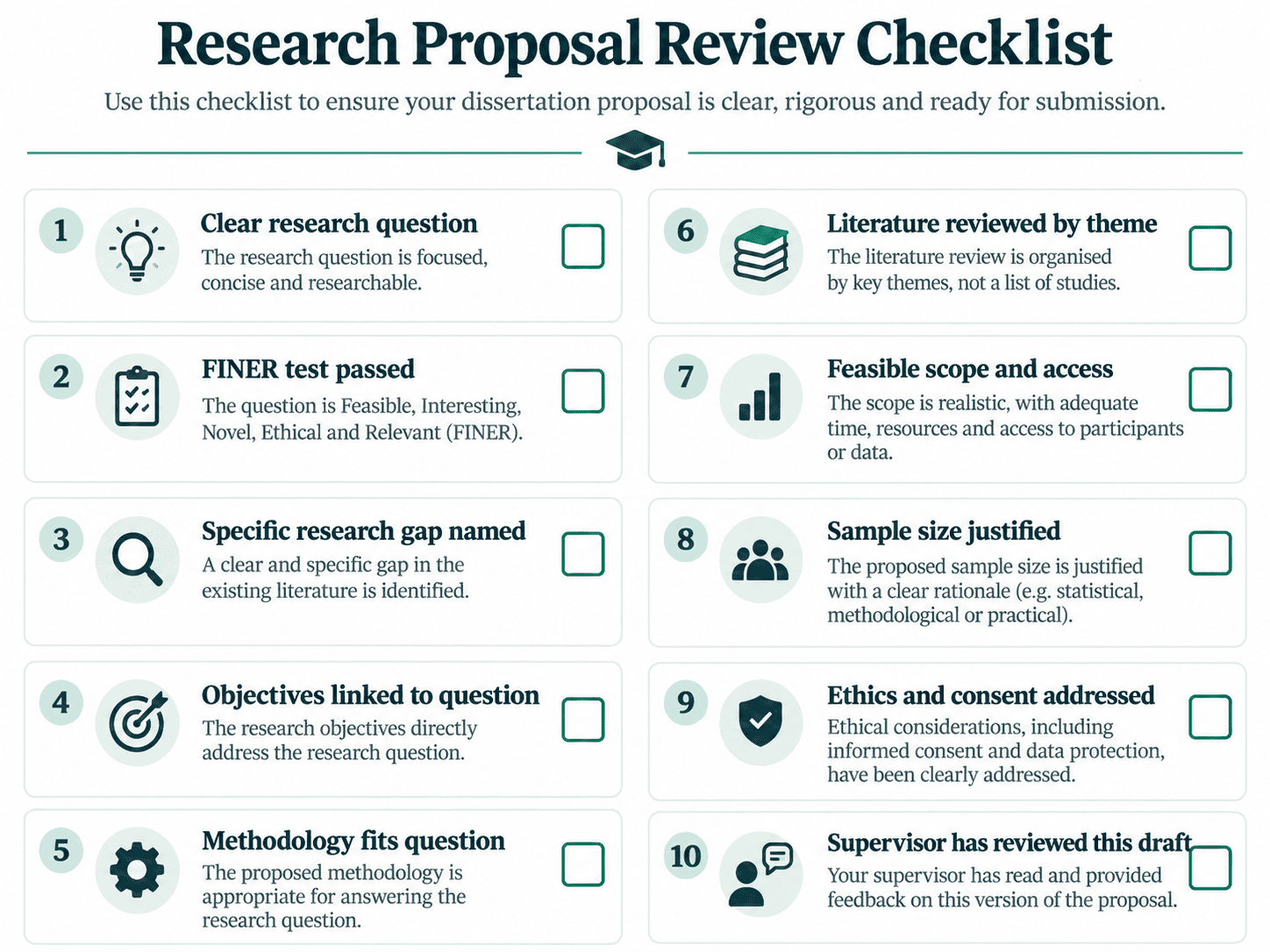
Use this checklist to catch dissertation proposal mistakes before your supervisor does.
- Can someone else restate your research question correctly after reading it once?
- Does your research question pass the FINER test, feasible, interesting, novel, ethical and relevant?
- Have you named the specific type of gap your study fills?
- Can every objective be traced back to your research question in one sentence?
- Does your methodology match what your research question is actually asking?
- Is your literature review organised by theme, not just paper by paper?
- Could your project realistically be finished with your current time and access?
- Is your sample size backed by a calculation, not a guess?
- Have you addressed ethics and consent if your study involves real participants?
- Has your supervisor already seen and commented on this exact draft?
If you answered no to more than two of these, fix those sections before you submit, not after.
How to Fix a Rejected Dissertation Proposal
Fixing dissertation proposal mistakes after rejection follows the same four steps every time.
- Read the feedback like a reviewer, not like personal criticism. Separate every comment into “quick fix” and “needs rework” before you touch the document.
- Decide early if you need a targeted fix or a structural rewrite. Don’t waste a week patching a proposal that actually needs its research question rebuilt from scratch.
- Fix the weakest section first, usually the research question or the gap statement, since almost every other section depends on it.
- Get a second, qualified pair of eyes on the revised draft before you resubmit. Your supervisor has already seen the original once and may miss the same issue twice.
Frequently Asked Questions
How many times can a dissertation proposal be rejected?
There is no fixed limit at most universities, but two or three rounds is typical before a programme raises concerns about your timeline. Each resubmission needs to fix the actual issue raised, not just reword the same section.
What happens if your dissertation proposal is rejected?
Most of the time, nothing permanent. Committees generally use one of two outcomes, a straightforward desk rejection with written feedback, or a formal “revise and resubmit” decision with a set deadline. Either way, you revise the flagged sections and resubmit within the window your department gives you.
How long should a dissertation proposal be?
Most proposals run between 1500 and 3000 words, though this varies by university and by whether a full literature review chapter is expected at this stage.
What is the difference between a dissertation and a dissertation proposal?
A proposal is a plan, it describes what you intend to do and why. A dissertation is the finished research, with your actual findings, analysis and conclusions.
What is the difference between a dissertation proposal and a research proposal?
In practice, the two terms are used interchangeably at most universities. Where they differ, a research proposal is the broader term for any funded or unfunded project, while a dissertation proposal specifically refers to the version required for degree approval, tied to your department’s own format and committee process.
How do you fix a rejected dissertation proposal?
Read the reviewer feedback carefully, decide if you need a small fix or a structural rewrite, rebuild the weakest section first (usually the research question or the gap), and get a second opinion before resubmitting.
What makes a research methodology weak?
A methodology is weak when it does not match what the research question is actually asking, when the sample size has no justification behind it, or when the choice is based on familiarity rather than fit.
What should I expect at my proposal defence?
A proposal defence, sometimes called a viva at this stage, is usually a 30 to 60 minute conversation where your committee tests if you can justify your research question, your method, and your feasibility out loud, not just on paper. Most of the questions map directly to the 12 dissertation proposal mistakes in this guide, so if you can defend each section against them in conversation, you are already prepared.
Final Thoughts
None of these 12 dissertation proposal mistakes are really about talent or how smart your research idea is. They are about whether your proposal proves, on paper, that you have thought the plan through end to end. Fix the proof, and most proposals go from rejected to approved on the very next submission.
If you have been through two rejections already and are not sure which of these 12 mistakes applies to your draft, here is how to know if you need a dissertation expert to look at it before you resubmit again.
Written by Siddharth Gupta, dissertation and research consultant with 12 years of experience, having reviewed and corrected over 300 dissertation proposals across the US, UK and India. Connect on LinkedIn.