
12 Warning Signs of Dissertation Data Collection Problems (Before Your Study Fails)
Dissertation data collection problems rarely show up during your proposal defence. They show up six weeks into fieldwork, when your response rate is stuck at nine percent and your committee wants an update you do not have.
I review failed data collection plans every month as part of my work, and after twelve years of doing this, I can usually tell which plan is going to collapse before the student even finishes describing it. The pattern repeats itself across quant studies, qual studies, STEM labs, and social science surveys alike.
This is not a list of vague warnings. Every sign below is something you can check in your own plan today, before you launch anything. If three or more of these apply to you, fix your plan now. Do not wait for week six to find out the hard way.
The 12 Warning Signs at a Glance
| Warning sign | Why it happens | Quick fix |
|---|---|---|
| 1. No real access to your population | Population is theoretically reachable, not actually reachable | Name a specific list, gatekeeper, or community today |
| 2. Questionnaire over 15 minutes | Nobody timed it with a real person | Cut to what answers your research question directly |
| 3. Response rate based on guesswork | Borrowed benchmark from the wrong type of survey | Use a comparable study plus a calculated buffer |
| 4. No time budgeted for ethics approval | Assumed approval is instant | Budget four to six weeks minimum, more in vacation periods |
| 5. One recruitment channel only | No redundancy if it underperforms | Map two or three channels before launch |
| 6. Instrument never piloted | Skipped as a formality | Pilot with five to eight people from your target population |
| 7. Hidden or hard to reach population | No public list exists for this group | Use snowball sampling through trusted intermediaries |
| 8. No plan for incentives or fatigue | Assumed goodwill is enough | Add a modest incentive, watch pilot feedback closely |
| 9. Gatekeeper access is informal | Verbal yes from one contact | Get it in writing, with a named contact |
| 10. Collection window hits a bad season | Did not check the population’s calendar | Time launch around their busy period, not yours |
| 11. No plan B if numbers fall short | No trigger point decided in advance | Set a number and week that triggers a strategy change |
| 12. Committee reviewed theory, not logistics | Feedback focused on literature, not recruitment | Ask your chair who has recruited this population before |
Each one is explained in full below, with the specific fix.
What Causes Dissertation Data Collection Problems in Research
A dissertation data collection plan is the specific, operational description of how you will get your data. It covers who you will recruit, how many of them, through which channel, using what instrument, and inside what timeframe. This is different from your research design. Your design says you will run a survey. Your plan says exactly how 220 working professionals in Mumbai and London will hear about that survey and why they will actually bother finishing it.
Most common data collection problems in research trace back to one root cause. The plan was written to satisfy a committee on paper, not tested against reality. A plan can be theoretically sound and still be operationally impossible, and nobody checks that gap until data collection has already started.
If you are still undecided on where your data will even come from, sort that out first. Read choosing between primary and secondary data before you lock anything else in your plan.
In my experience, these problems rarely show up as one obvious mistake. They show up as small assumptions nobody questioned, that access would be easy, that people would want to fill a 25 minute survey, that a 20 percent response rate seen in a general population survey would also apply to a narrow professional group. Each assumption alone looks reasonable. Stacked together, they sink the study.
Sign 1. Dissertation Participant Recruitment Problems Start with No Real Access
How to test real access before you commit
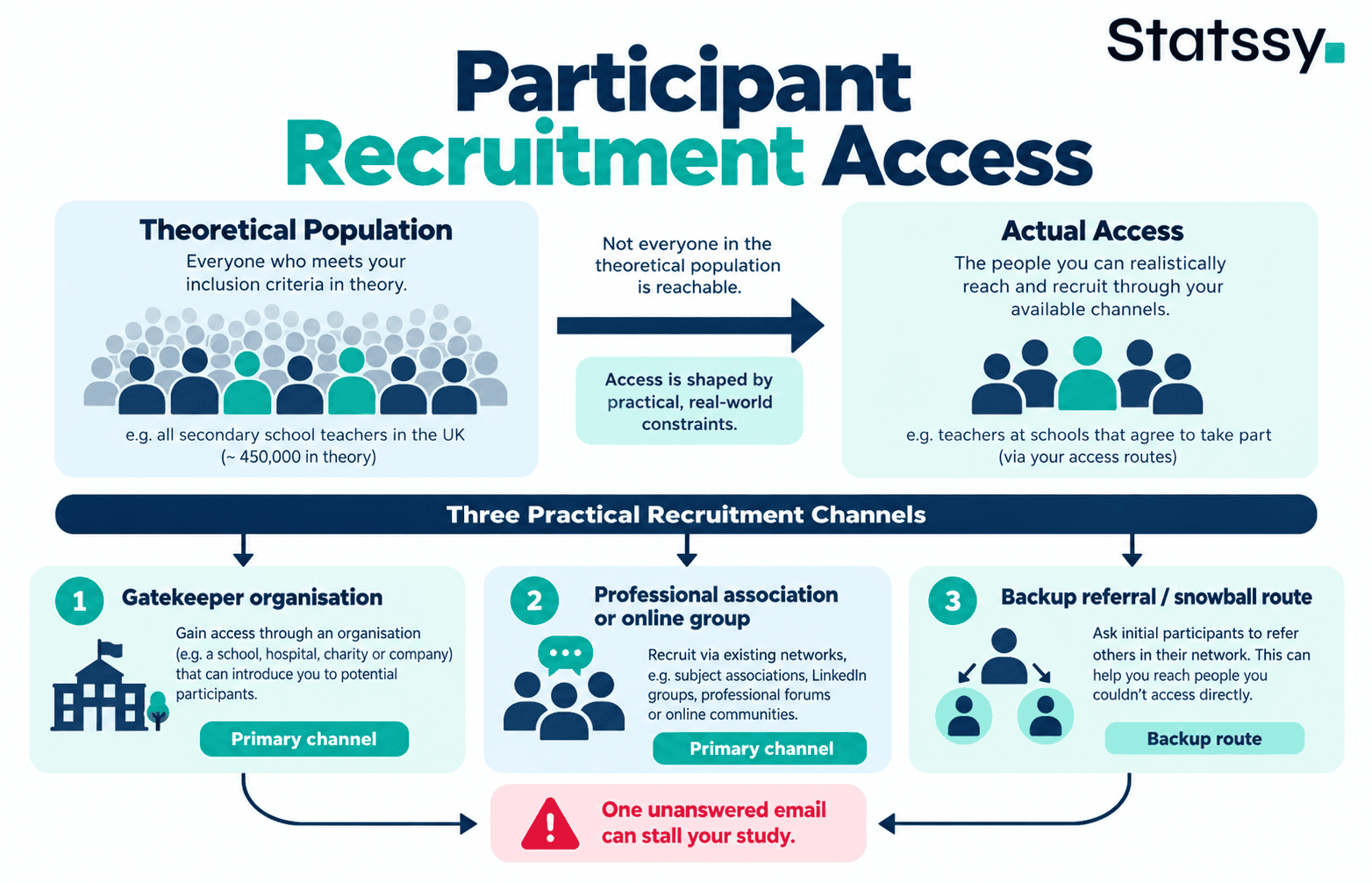
The single biggest dissertation participant recruitment problem I see is students confusing “theoretically reachable” with “actually accessible.” Yes, there are thousands of nurses in the UK. That does not mean you can get 150 of them to respond to your survey in six weeks.
Ask yourself one honest question before you commit to a population. Who, specifically, will I send this survey to tomorrow if I had to? If you cannot name an actual list, a gatekeeper, or a community you already belong to, your access is theoretical, not real.
I had a client last year whose plan assumed access to “small business owners in London.” Approved on paper, fine on the surface. In reality she had no list, no association contact, and no existing network. We rebuilt her recruitment around three trade associations she could genuinely approach, and her numbers improved within two weeks.
Backup access routes
Always have a second and third route into your population ready before launch. If your primary access depends on one gatekeeper, you are one unanswered email away from a stalled study.
Good backup routes include:
- A second gatekeeper organisation in the same sector
- Relevant professional groups where posting is permitted
- Snowball referrals from your first ten respondents
- Your own university’s participant pool, if it fits your population
Sign 2. Your Questionnaire Takes Longer Than 15 Minutes
Why length kills completion rate
People start surveys with good intentions and abandon them out of fatigue, not malice. Every extra screen is a fresh decision point where someone can simply close the tab. A 30 minute questionnaire does not get 30 minutes of patience from a stranger, it gets eight.
That drop-off is one of the most common dissertation data collection problems in online research right now, because most respondents are already juggling several other surveys competing for the same attention. The same discipline applies whether you choose an online survey or in person interviews, shorter and sharper always outperforms longer and thorough, regardless of channel.
How to cut a survey down without losing data quality
Cutting length is not the same as cutting content. Before you delete a single question, sort your items into “answers my research question directly” and “would be nice to know.” Keep the first group, archive the second for a follow up study you are not currently running.
I tell every student the same thing here, and I will say it plainly because nobody else seems to. A long questionnaire is usually a sign the researcher has not decided what they actually need to know yet, and they are trying to ask everything so they do not have to decide. Fix the thinking, and the questionnaire shortens on its own.
If you are still weighing whether a structured questionnaire is even the right instrument for your research question, compare it against case study versus survey research designs before you spend more time trimming questions nobody needed.
Sign 3. Low Survey Response Rate in Dissertation Research Starts with Guesswork
What response rate is actually realistic for your population
For an unsolicited online survey sent to a general population, expect somewhere between 10 and 20 percent, not the 26 to 40 percent figures you will often see quoted on marketing research blogs. Those numbers are usually pulled from customer satisfaction surveys sent to people who already have an existing relationship with the brand, not cold outreach to strangers. Treating a marketing benchmark as your dissertation target is one of the most common research data collection planning mistakes I see in proposal meetings. It is almost always the first number I correct in a review.
A low response rate does not just shrink your sample. It introduces nonresponse bias, where the people who did not answer differ systematically from the people who did, and your results end up describing the wrong group entirely. Published research on fixing low response rates in online surveys backs this up, well designed invitations, personal framing, and multiple reminder waves consistently outperform a single blast email.
How to calculate minimum sample size with a buffer
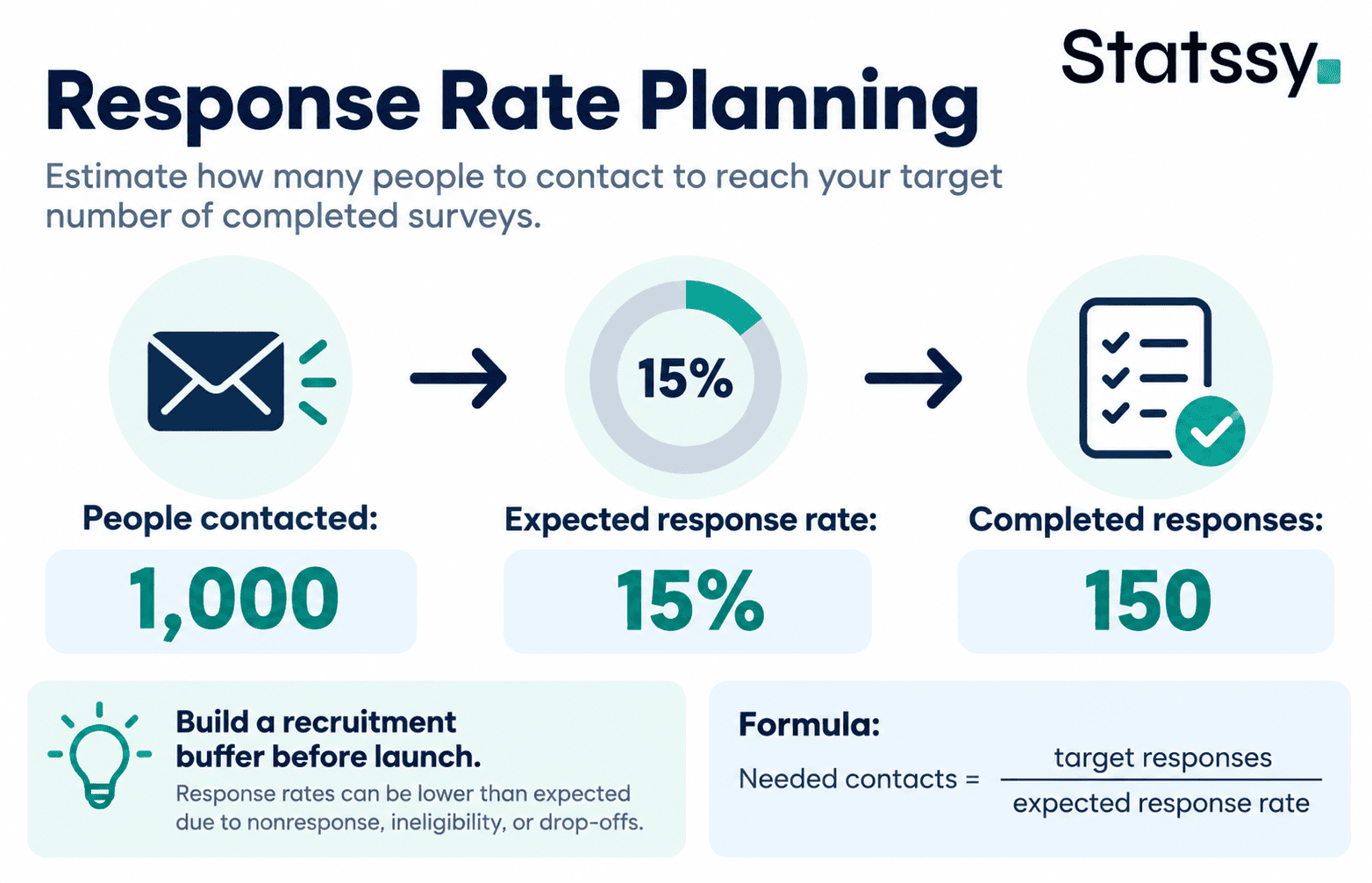
Before you lock your target number, run it through a sample size calculator rather than picking a round number because it looks respectable on paper. Then build in a response rate buffer. If you need 150 completed responses and expect a 15 percent response rate, you need to reach roughly 1,000 people, not 300.
This is also where a basic power analysis earns its place in your methodology chapter. Even a simple one shows your committee the number was calculated, not guessed, and that single addition heads off a whole category of common data collection problems in research before they start.
Sign 4. You Have Not Budgeted Time for Ethics or IRB Approval
Typical approval timelines
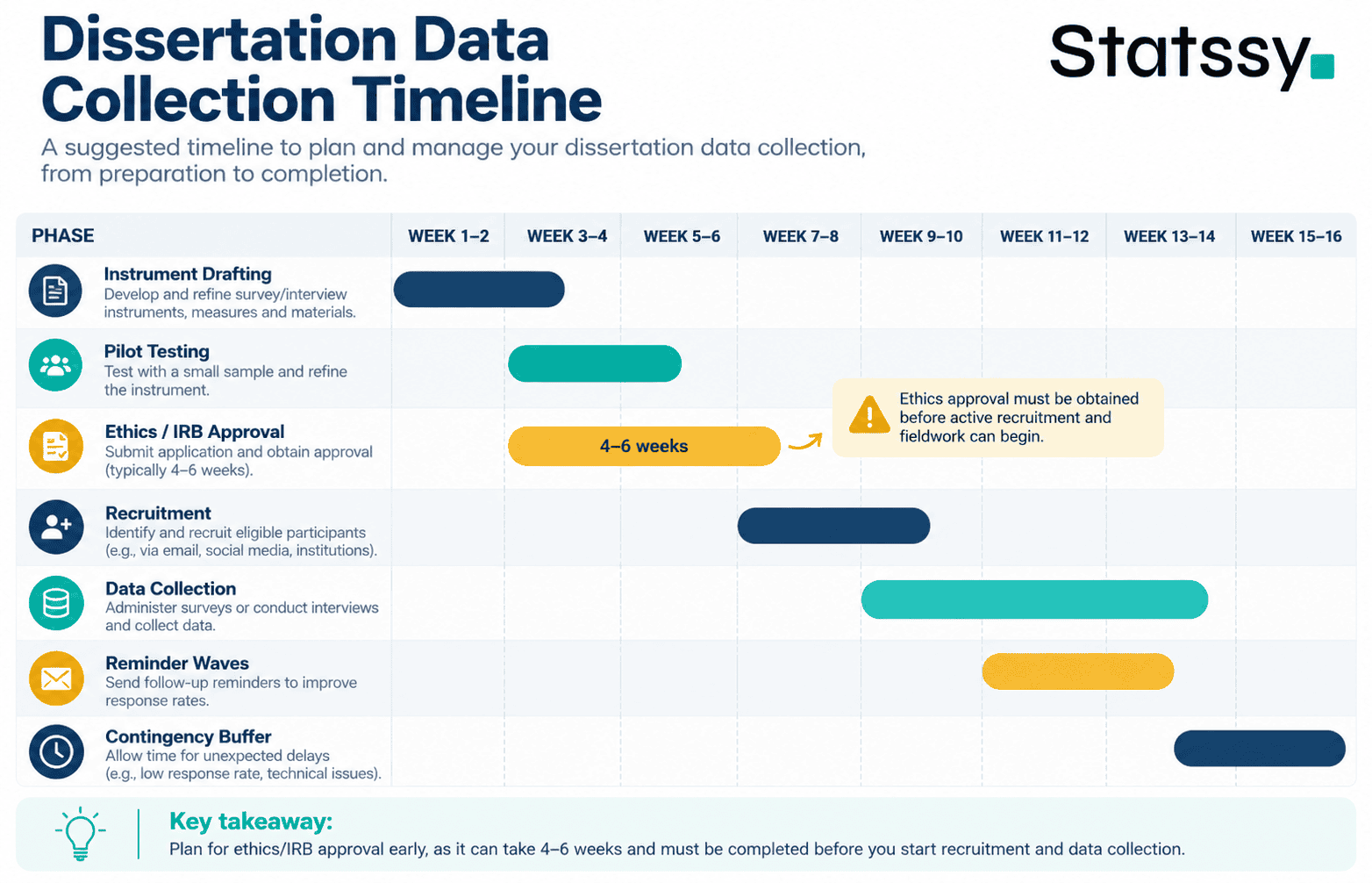
Most university ethics committees take four to six weeks to approve a standard dissertation application, and that is before any requested revisions. Submit during a holiday period or exam season and that timeline stretches further. Students who schedule data collection to start “right after approval” with zero buffer are setting themselves up to fail before they have collected a single response.
One university’s published IRB review timeline puts expedited review at four to six weeks on average, which lines up with what I see across most institutions. These timelines sit inside a wider regulatory frame, the Common Rule in the US and Research Ethics Committee requirements in the UK. That is exactly why there is no realistic shortcut around them.
What delays approval most often
Incomplete consent forms, vague descriptions of how data will be stored, and recruitment materials that were not attached all cause the same back and forth that eats weeks. Submit a complete, specific application the first time and you avoid most of this entirely.
Sign 5. Relying on One Channel Is a Classic Research Data Collection Planning Mistake
Why single channel recruitment collapses
A plan built around one Facebook group, one mailing list, or one gatekeeper organisation has no redundancy. The moment that channel underperforms, your entire timeline collapses with it, and you have nothing to fall back on while you scramble for an alternative.
Building two or three backup channels
Map out two or three recruitment channels before launch, not after your first one disappoints you. Stagger them, start with your strongest channel, and have the second ready to activate the moment week one numbers come in below target.
Sign 6. You Have Not Piloted Your Instrument
What a pilot test actually catches
A pilot test is not a formality for your methods chapter. It is the only way to find out that question seven is confusing, that your survey takes 22 minutes instead of the 12 you estimated, or that your interview guide has an awkward gap nobody noticed while writing it.
Minimum viable pilot size
You do not need 50 people for a useful pilot. Five to eight participants from your target population, walked through the instrument with you watching or debriefing immediately after, will surface almost every major problem. Skip this step and you find those same problems live, with real data on the line.
Sign 7. Your Sample Is a Hidden or Hard to Reach Population
Snowball and gatekeeper strategies
Populations like informal sector workers, specific patient groups, or undocumented professionals do not sit on any public list. For these groups, snowball sampling through trusted intermediaries is usually your only realistic path, and that is fine as long as you can justify it methodologically. See making convenience sampling defensible in a dissertation for how to write that justification properly instead of apologising for it in your limitations section.
Convenience sampling is different from random sampling, where every person in the population has an equal chance of selection. You are not claiming your sample represents the whole population statistically. You are claiming it is the most defensible route available for a group with no accessible sampling frame. If your population can support a stronger structure, weigh it against stratified or cluster sampling before you default to convenience out of habit.
Realistic timeline adjustment
Hidden populations take two to three times longer to recruit than general population samples. If your timeline does not reflect that multiplier, it is not a realistic timeline, it is a hopeful one.
Sign 8. You Have Not Planned for Incentives or Participant Fatigue
Low cost incentive options for self funded students
You do not need a large budget to improve participation. A prize draw for a modest gift voucher, early access to your findings summary, or simply a genuinely well written, respectful invitation message all move the needle more than most students expect.
Early warning signs of survey fatigue
If your pilot participants mention the survey “feels long” even once, believe them. That single comment from a pilot is worth more than your own assumption that the length is fine because you wrote every question yourself.
Sign 9. Your Gatekeeper Relationship Is Informal
Why a verbal yes is not enough
One of my clients last year had verbal permission from a factory HR manager to survey employees on site. Three weeks before launch, that manager left the company, and the replacement refused access outright. She lost six weeks rebuilding her participant pool from nothing, purely because this dissertation data collection problem was never put in writing.
Getting access in writing
Get access agreements in writing, with a named contact, before you submit your ethics application, not after. A verbal yes from one person can evaporate the moment that person changes roles, and your dissertation timeline does not get to pause while you wait for a new one.
Sign 10. Your Collection Window Overlaps a Bad Season
Academic calendar, holidays, and industry busy seasons
Launching a student survey during exam week, or a retail employee survey during the holiday shopping season, guarantees a lower response rate regardless of how good your instrument is. People are not ignoring your research, they are drowning in everything else that week.
I have watched two otherwise identical dissertation data collection plans produce completely different results purely because of timing, one launched in a quiet week, one launched during exam season.
Timing your launch correctly
Check your population’s calendar, not just your own academic calendar, before you set a launch date. A finance sector survey during year end close will underperform no matter how well designed it is.
Sign 11. You Do Not Have a Plan B If Numbers Fall Short
Triggers for switching strategy mid collection
Decide in advance what number, at what point in your timeline, triggers a change in strategy. Waiting until week eight to admit your numbers are bad wastes the exact weeks you needed to fix it.
When to go back to your committee
If your realistic plan B involves a different recruitment channel or a modified eligibility criterion, flag it to your committee early rather than silently switching strategies midway and hoping nobody asks.
Sign 12. Your Committee Reviewed the Theory, Not the Logistics
Questions to ask your chair before launch
Ask your chair directly, who specifically have you seen successfully recruit this population before, and how long did it take them? If the honest answer is “nobody I know has tried exactly this,” that is useful information, not a reason to panic, but you need to plan for it.
If the real problem sitting underneath all of this is that your design itself does not match your research question, no amount of fixing the logistics will save it. That is a separate dissertation data collection problem, worth sorting out through choosing an appropriate research design before you touch your recruitment plan at all.
Red flags in committee feedback
If your proposal defence feedback focused entirely on your literature review and barely touched your data collection plan, that is not approval, that is an unreviewed section waiting to cause trouble later.
Run Your Plan Through This Self-Audit Checklist Before You Launch
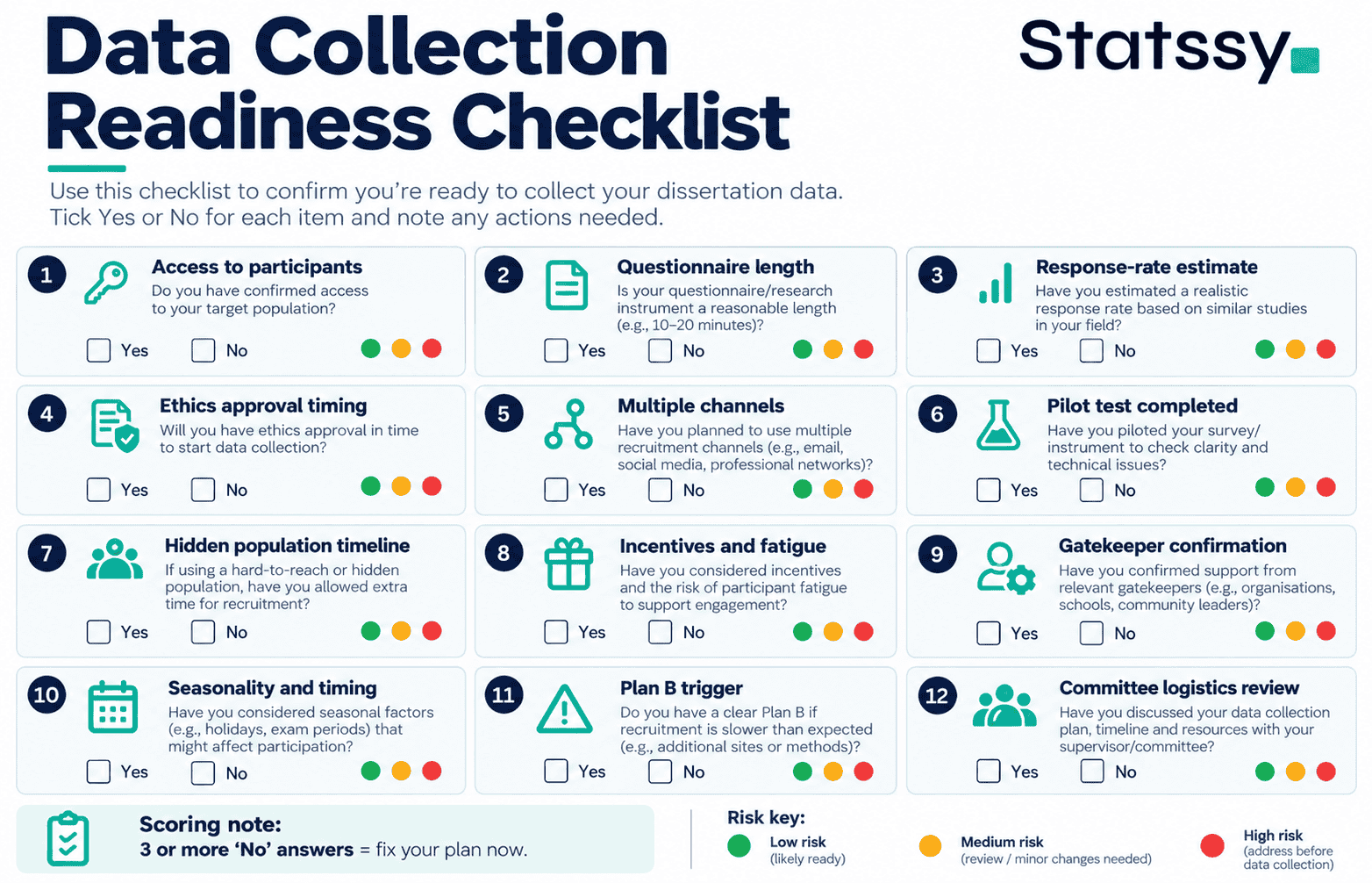
Score yourself honestly against each item. Every “no” is a dissertation data collection problem waiting to happen.
- I can name the actual list, gatekeeper, or community I will use to reach participants.
- My questionnaire has been timed by a real person and takes 15 minutes or less.
- My expected response rate is based on a comparable study, not a round number that looked reasonable.
- I have budgeted at least six weeks for ethics approval, with no overlap assumed.
- I have at least two independent recruitment channels mapped out.
- I have piloted my instrument with five or more people from my target population.
- My timeline accounts for my population being hard to reach, if it is.
- I have a plan for incentives or participant fatigue, even a small one.
- Any gatekeeper access I am relying on is confirmed in writing, with a named contact.
- My collection window avoids my population’s busiest or least available season.
- I have decided in advance what number, at what week, triggers a change in strategy.
- My committee has reviewed my recruitment logistics specifically, not only my research design.
If you scored three or more “no” answers, treat that as your to-do list for this week, not a footnote for your limitations chapter.
How to Fix Data Collection Problems in Dissertation Research
Minor fix versus full redesign
Not every warning sign above needs a full rebuild. A long questionnaire needs editing, not a new research design. No real access to your population needs a different, more realistic group, which usually does need committee sign off.
Use this rule of thumb. If the fix changes your sample, your population, or your core research question, it is a full redesign and your committee needs to see it. If the fix only changes how you reach the same population, with the same instrument, it is usually a minor revision you can make yourself and simply document.
When to go back to your ethics board
Any change to your recruitment method, your consent process, or your population needs to go back through your ethics board, even if it feels like a small practical tweak from where you are standing. Skipping that step to save time is how a slow response rate turns into a bigger dissertation data collection problem than it needed to be.
If you want a second, more experienced pair of eyes on your plan before you launch anything, that is exactly where getting expert feedback on your dissertation proposal from someone who has seen these failures before is worth the hour it takes.
That is the whole point of writing this down. I would rather you catch a dissertation data collection problem on a Tuesday afternoon reading this, than six weeks into fieldwork with a committee meeting already on your calendar. If you want someone to actually sit with your plan line by line before you launch, that is the kind of review we do at Statssy.
Frequently Asked Questions
What is a good response rate for a dissertation survey?
For an unsolicited online survey to a general population, 10 to 20 percent is realistic. For a survey sent to a population you have direct access to, through an organisation or professional network, 25 to 40 percent is achievable with good follow up.
How many participants do I need for a qualitative dissertation?
Most qualitative dissertations reach adequate depth somewhere between 12 and 20 participants, depending on how tightly defined your population is and how quickly you reach data saturation, the point where new interviews stop producing new themes.
Can a dissertation fail because of data collection problems?
Yes. A dissertation does not usually fail because of one dramatic error, it fails when a data collection plan quietly produces insufficient or unreliable data, and nobody catches it early enough to fix it before the deadline.
Can I change my data collection plan after ethics approval?
Yes, but any change to your population, consent process, or recruitment method needs to go back through your ethics board as a formal amendment before you implement it, not after.
How early should I pilot test my dissertation survey?
Pilot test as soon as your instrument is drafted, well before you submit your final ethics application if possible, so that any changes the pilot reveals do not require a second approval round.
What should I do if my data collection plan gets rejected?
Ask your chair or ethics board specifically what triggered the rejection, logistics, ethics, or design, because the fix is completely different depending on which one it actually was.
How long should a dissertation questionnaire be?
Aim for 15 minutes or less of actual completion time, timed with a real person from your target population, not estimated from how long it takes you to read through it yourself. Past that point, completion rates drop off sharply.
What counts as a low response rate for a dissertation?
Anything under 10 percent for a cold, unsolicited online survey is a warning sign, and anything under 20 percent for a survey sent through a trusted gatekeeper deserves a second look at your recruitment strategy before you proceed.