
One Tailed vs Two Tailed Test SPSS – What Your Hypothesis Needs
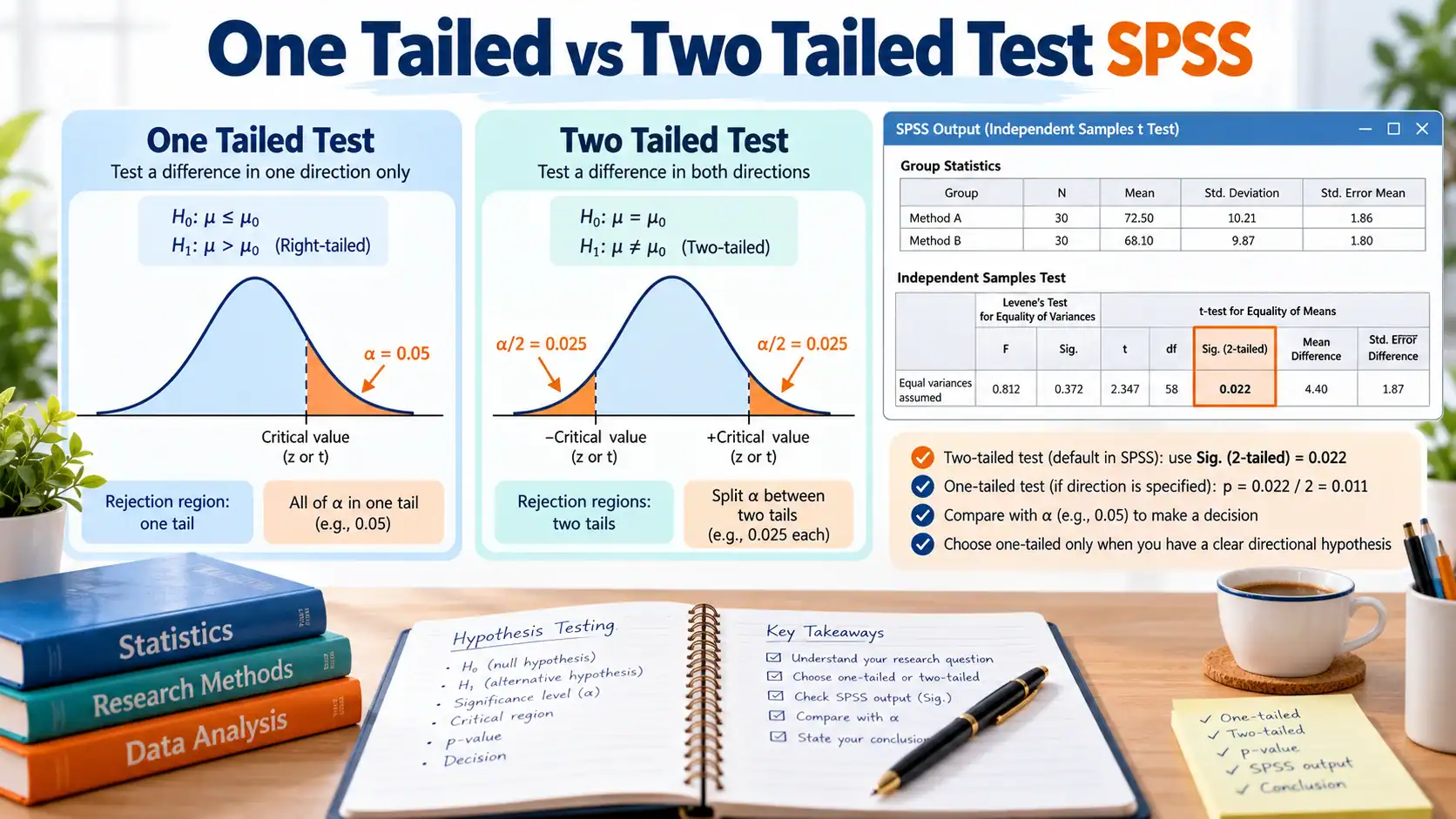
One tailed vs two tailed test SPSS confusion is the single most common question I get from dissertation students in twelve years of guiding research.
Every semester somebody lands in my inbox with the same panic. They ran a perfectly fine test in SPSS, wrote up their hypothesis with confidence, and then a committee member crossed out half their results chapter in red ink.
Nine times out of ten, the problem is not the data. Nobody explained how to choose one tailed or two tailed test before SPSS was even opened.
Let me fix that properly, with the SPSS screens, the wording checklist, and a real story from one of my students.
What One Tailed and Two Tailed Tests Actually Mean
A two tailed test checks whether a result is different from a fixed value, in either direction. A one tailed test checks whether the result differs in only one specific direction, either higher or lower, never both.
That single line is the entire concept. Everything else in this article is just helping you apply it correctly to your own hypothesis and your own SPSS output.
Non-Directional Hypothesis Equals Two-Tailed
If your hypothesis says “there is a difference” or “X is related to Y,” you are not predicting which way the result goes. That is a non-directional hypothesis, and it needs a two tailed test.
Directional Hypothesis Equals One-Tailed
If your hypothesis says “X is greater than Y” or “X reduces Y,” you are committing to a direction before you have seen the data. That is a directional hypothesis in SPSS terms, and it needs a one tailed test. In formal notation, this looks like H0: µ ≤ 15 and H1: µ > 15, where the inequality points only one way. A two tailed version of the same hypothesis instead reads H0: µ = 15 and H1: µ ≠ 15.
Quick Comparison Table
| Feature | Two Tailed Test | One Tailed Test |
|---|---|---|
| Hypothesis wording | “differs from,” “is related to” | “is greater than,” “increases,” “reduces” |
| Rejection region | Both ends of the distribution | One end only |
| Alpha split (for alpha 0.05) | 0.025 on each side | 0.05 on one side |
| Statistical power | Lower for the same sample size | Higher, only if direction is correct |
| Dissertation committee view | Default expectation, rarely questioned | Scrutinised, needs justification |
A two tailed test pairs with a standard two-sided confidence interval, while a one tailed test technically calls for a one-sided interval, something most SPSS output does not give you directly.
How to Choose One Tailed or Two Tailed Test Based on Your Hypothesis Wording
Getting your directional hypothesis SPSS test right starts with how you word the hypothesis itself, long before you touch SPSS. This is the part nobody explains properly, so students end up guessing after the data is already collected, which is exactly the problem I come back to in the next section.
Wording That Signals a Two-Tailed Test
- “There is a significant difference between…”
- “X is related to Y”
- “There is an association between…”
Wording That Signals a One-Tailed Test
- “X is significantly higher than Y”
- “The intervention reduces…”
- “Increased exposure leads to greater…”
A Three-Question Self-Check
Ask yourself these three questions before you touch SPSS.
- Did I predict a direction before collecting any data, based on theory or prior research?
- Would a result in the opposite direction still be meaningful for me to report?
- Can I defend this direction using a citation, not just a gut feeling?
If you answered no to even one of these, go two tailed. It is the statistically honest position, and most of academia will back you on it.
Why Most Dissertation Committees Expect Two Tailed by Default
I have read a fair bit of the academic literature on this question, and most of it leans hard against one tailed testing, sometimes for good reason and sometimes out of plain institutional habit. A two tailed test dissertation defence rarely runs into committee trouble, and that safety record is exactly why it has become the universal default.
The Type I Error Control Argument
Paul Cairns, in his Cambridge University Press chapter on this exact question, argues that one tailed testing is risky. His concern is that it can look like a way to make significance easier to reach. He recommends two tailed testing as the safer choice in almost every case.
I agree with the caution. But I think the argument overstates the point. If you genuinely predicted the direction before seeing the data, and you can prove it with a citation or an approved proposal, a one tailed test simply matches your test to your theory.
Why Directional Hypotheses Invite Suspicion
Karl Wuensch, in his psychology methods resource at East Carolina University, makes a related point. He notes that directional hypotheses are often treated with suspicion because reviewers assume the direction was chosen only after the researcher peeked at the results. That suspicion is fair more often than students like to admit. I have personally watched students discover a direction only after running a two tailed test first and noticing which way the effect happened to go. That is p-hacking with extra steps, and committees are right to flag it.
Need help with one-tailed versus two-tailed hypothesis testing?
Get practical support with aligning your directional hypothesis with the correct significance test.
Check My Hypothesis Test on WhatsAppWhere the Norm Is Strongest and Where It Loosens
Psychology and education sit closest to the strict two tailed default. Business, marketing, and applied health research sit a little further from it, because directional hypotheses there are often backed by established prior evidence rather than pure theory. If you are studying in the UK, your supervisor or an examiner at your viva will ask you exactly the same question a US committee member asks, just in different words.
My honest read, after sitting through more committee defences than I can count, is this. Two tailed is the safe, defensible, almost always accepted default. One tailed is defensible only when you can show, on paper, before you ran anything, exactly why you expected one direction and not the other.
Case Study – The Student Whose One Tailed Test Got Flagged
The Hypothesis As Written
A student I worked with (details changed to protect her privacy) was testing whether a new teaching method improved exam scores compared to the traditional method. Her hypothesis read “the new method will result in higher exam scores,” so she ran a one tailed independent samples t-test in SPSS.
What the Committee Member Said
Her second committee member stopped her at the proposal defence stage. He told her plainly that she had not shown any theory or prior study predicting that specific direction, and that until she did, the test needed to stay two tailed.
How It Got Fixed Without Re-Running Anything
She had two realistic options, and we picked the faster one. Instead of re-running her analysis, we went back into her literature review and found two prior studies that already supported her predicted direction, studies she had cited but never explicitly tied to her test choice. We added one short paragraph in her methodology section connecting that citation directly to the one tailed test.
The committee accepted it at her next meeting. Nothing about her SPSS output changed at all. What changed was that her test choice now had a paper trail behind it, and that paper trail is usually what committees are actually asking for in the first place.
Running and Reading One Tailed vs Two Tailed Tests in SPSS
This is where most students get stuck technically, because SPSS does not hand you a one tailed p-value on a plate.
Why SPSS Defaults to Two-Tailed Sig Values
Open any t-test output in SPSS (Analyze, then Compare Means, then Independent-Samples T Test) and you will see a column labelled “Sig. (2-tailed).” SPSS reports the two tailed significance by default because it assumes you have not committed to a direction unless your methodology section says otherwise.
The Divide-by-2 Method and the Step Everyone Skips
If your hypothesis is genuinely directional, you can get a one tailed p-value from that same SPSS output. There is a check you must do first, and skipping it is the single most common mistake I see.
- Look at the sign of the t-value in your output. It must match the direction your hypothesis predicted.
- If the sign matches your predicted direction, divide the two tailed Sig. value by 2. That is your one tailed p-value.
- If the sign does not match, your one tailed p-value works out close to 1 minus half the two tailed value, and you will almost certainly fail to reject the null.
Step 1 is the step everyone skips. Halving a p-value without checking the direction first is how people accidentally report a significant result that actually went the opposite way from what they predicted.
What Changed in Newer SPSS Versions
From SPSS 27 onward, some procedures (the independent samples t-test among them) show a one-sided significance column directly alongside the effect size statistics, so you do not always need to calculate anything by hand anymore. Check your output table headers carefully before assuming you need to do the division yourself.
If your data has not passed a normality check yet, sort that out before you trust any of these significance values.
One Tailed vs Two Tailed Tests in SPSS for Psychology and Behavioural Research
Why This Field Leans Two-Tailed by Convention
Psychology, more than almost any other field, treats two tailed as the house default. The reason traces back to replication concerns. Too many “predicted” directional effects in older psychology papers turned out to be post-hoc stories dressed up as predictions after the fact.
A Worked Example
If your hypothesis is “participants exposed to condition A will show higher anxiety scores than condition B,” be ready to defend that direction with a named theory, not just intuition. If your design is within-subjects rather than between-groups, your test choice changes too, which is worth comparing against our paired t-test vs repeated measures ANOVA guide.
One Tailed vs Two Tailed Tests in SPSS for Nursing and Health Sciences
Why This Field Sits in the Middle Ground
Health sciences research often gets more leeway on directional hypotheses than psychology does, mainly because clinical outcomes are frequently backed by earlier trial evidence rather than pure theory.
A Worked Example
A hypothesis like “the intervention group will report lower pain scores than the control group” is directional, and it is usually supported by prior clinical research your committee can check. Whether that evidence holds up often comes down to your study design, since a one-off cross-sectional comparison carries far less weight than a longitudinal trial. Run a normality check on your outcome variable before you commit to a parametric test here, because pain scores and recovery times are notoriously non-normal, which changes your test choice before tailedness even enters the picture.
One Tailed vs Two Tailed Tests in SPSS for Business, Marketing, and Management Research
Why This Field Is More Comfortable With One-Tailed Tests
This is the field where I see committees push back the least on directional hypotheses. A claim like “the new pricing strategy increases average order value” is built directly on established business logic, and reviewers here are usually more comfortable with a predicted direction.
A Worked Example
If your hypothesis is about a relationship rather than a group difference, check whether Pearson or Spearman correlation fits your data first. Tailedness applies to correlation coefficients too, not only to t-tests, and the same logic extends to regression. A directional hypothesis such as “higher ad spend predicts higher revenue” tests one sign of the coefficient, not both, which is still a one tailed call even though you are running a regression, not a t-test.
One Tailed vs Two Tailed Tests in SPSS for Education Research
Why This Field Sits Closer to Psychology’s Caution
“Method X improves test scores over Method Y” needs backing, usually from a prior classroom study or a named pedagogical theory, before a committee lets a one tailed version of this hypothesis through.
A Worked Example
If you are comparing more than two teaching methods at once, you have moved into ANOVA territory, and the tailedness question shifts to your post-hoc comparisons as well.
One Tailed vs Two Tailed Tests in SPSS for Social Sciences and Economics
Need help with one-tailed versus two-tailed hypothesis testing?
Get practical support with interpreting and reporting the correct one- or two-tailed SPSS result.
Review My SPSS Test Results on WhatsAppWhy This Field Defaults to Two-Tailed Almost Universally
Economics and broader social science research tends toward two tailed testing because so much of this work is exploratory rather than confirmatory. You are often testing whether a relationship exists at all, not confirming a direction you already expected going in.
A Worked Example
Where a directional hypothesis does show up here, it is usually anchored to an established economic theory, such as diminishing returns, and your committee will expect you to name that theory explicitly in your methodology chapter. A lot of this research also leans on secondary data such as World Bank or government panel datasets, which is worth flagging early since it can affect which tests are even appropriate.
Reporting Your Result in APA Format
Two-Tailed Example
“An independent samples t-test revealed a significant difference in scores between Group A (M = 24.3, SD = 3.1) and Group B (M = 21.8, SD = 2.9), t(58) = 2.94, p = .005, two-tailed.”
One-Tailed Example
“As predicted based on prior theory (Author, Year), a one-tailed independent samples t-test showed that Group A scored significantly higher than Group B, t(58) = 2.94, p = .003, one-tailed.”
Notice that the one tailed write-up names its justification in the same sentence. Naming that justification is exactly what separates a defensible one tailed test from one that gets flagged at your next committee meeting.
Mistakes That Get Flagged by Committees and Reviewers
- Switching from two tailed to one tailed after seeing a borderline p-value. This is the fastest way to lose credibility with a committee, and most experienced reviewers spot it immediately.
- Halving the alpha level (0.05 to 0.025) instead of halving the reported Sig. value. These are two completely different calculations, and mixing them up hands you the wrong p-value entirely.
- Running a one tailed test without writing a single sentence in your methodology section justifying the direction. No justification, regardless of how correct your maths is, usually means a redo.
FAQ
Does SPSS Run a One Tailed Test Directly?
Not for most common procedures by default. Older SPSS output gives you only the two tailed Sig. value, which you convert yourself using the direction check explained above. Some newer versions provide a one-sided value directly for select procedures.
How Do I Convert a Two Tailed P-Value to a One Tailed P-Value in SPSS?
Check that the sign of your t-value matches your predicted direction first. If it does, divide the two tailed Sig. value by 2.
Is a One Tailed Test More Powerful Than a Two Tailed Test?
Yes, if your predicted direction is correct, because the entire rejection region sits on one side. If the actual effect runs the opposite way, a one tailed test will never detect it, no matter how strong that effect actually is, and that is a real Type II error risk you are accepting in exchange for the extra power. Before you commit to a one tailed design, it is worth running the numbers in G*Power or a quick sample size calculator so you know exactly what you are trading away.
Can I Switch From Two Tailed to One Tailed After Seeing My Results?
No. This is the rule committees enforce the hardest, and for good reason, because doing so defeats the statistical logic of hypothesis testing entirely.
Why Do Dissertation Committees Prefer Two Tailed Tests by Default?
Because a two tailed test does not require you to have predicted a direction in advance, which removes any question about whether you picked the direction only after seeing the data.
How Do I Report a One Tailed Test Result in APA Format?
State plainly that the test is one-tailed, name the prior theory or study justifying your predicted direction, and report the one-tailed p-value rather than the SPSS default two-tailed Sig. value.
If your committee has already questioned a test choice and you need someone to sanity check your SPSS output before your next submission, that is exactly the kind of fire I put out every week.
Written by Siddharth Gupta. Twelve-plus years of dissertation and research statistics guidance, one committee meeting at a time. Connect on LinkedIn.