
Dissertation Proposal Checklist – 12 Things to Check Before You Submit
A dissertation proposal checklist is the one thing most students skip because they assume “finished” means “ready,” and that assumption costs them two to three weeks of revision cycles with their supervisor.
Why Most Dissertation Proposals Get Sent Back
I have read somewhere between 400 and 500 dissertation proposals over 12 years of research and statistics consulting work, across psychology, business, public health and engineering programmes. The pattern is almost always the same. The student writes a complete proposal, every section is present, and it still comes back from the supervisor with three pages of comments.
Complete and ready are not the same thing. A proposal can have all the required sections and still fail on internal logic, where the research question does not match the design, or the sample size has no justification behind it.
Most checklists you find online do not help here. They tell you what sections a proposal needs (title, background, methodology, timeline), which is useful for a first draft but not much use at review stage, because you already know your proposal has those sections. What you actually need now is a dissertation proposal checklist that tests whether each section holds up under scrutiny, not whether it exists.
That is what this one does. Twelve checks, each written as a question your supervisor or ethics committee is likely to ask, from the reviewer’s side of the table rather than the student’s.
Your supervisor will catch most of these issues eventually. That is their job. But every round of comments costs you two to three weeks waiting for the next review slot, and a proposal that passes this checklist first usually needs one round of feedback instead of three.
What Should a Dissertation Proposal Include Before You Call It Ready
A dissertation proposal is a short written plan that states your research question, explains why it matters, and describes exactly how you intend to answer it. That is the definition in one line, and if your proposal does not answer all three parts clearly in the first two pages, it is not ready yet.
At minimum, your proposal should include a research question, clear objectives, a problem statement with justification, a literature review that identifies a gap, a theoretical or conceptual framework, a research design, a sampling strategy, a data collection plan, an analysis plan, ethics considerations, a feasibility statement covering time and resources, and correct formatting and referencing. That is 12 components, and each one becomes a checklist item below.
Here is the distinction most students miss. Complete means every one of those 12 components is present on the page. Ready means every one of those 12 components can survive a supervisor asking “why” about it, three times in a row. A proposal that is complete but not ready still gets sent back, just with a longer list of comments than a proposal that was never finished.
The 12-Point Dissertation Proposal Checklist
Work through these in order. Each one carries the one-line test I actually use when I review a student’s proposal before it goes to their supervisor.
1. Is your research question sharp enough
Your research question should be answerable within your timeline and specific enough that two different researchers would design broadly similar studies from it. If your question still has words like “explore” or “understand” doing all the work, with no variable or relationship named, it is still a topic, not a question.
2. Do your objectives actually answer your research question
List your 2 to 4 objectives next to your research question and check that answering all of them, together, answers the question. I see proposals regularly where the objectives drift sideways into related but separate territory. If an objective does not trace back to the question, cut it or rewrite the question.
3. Does your problem statement justify why this research matters now
A problem statement needs three things, the gap in current knowledge or practice, why it matters to your field or industry, and why now. “Not much research exists on X” is an observation, not a justification. Reviewers want to see consequence, what happens if this gap stays unaddressed.
4. Does your literature review show a real gap, not just a summary
A literature review that only summarises what other researchers found, without stating clearly what they did not address, is doing half the job. Your reader should be able to underline one sentence in your literature review and know exactly what your study will add that nobody else has. Pressure-test this before you write it up, list what each major study you cite did not cover, then check that your research question sits inside one of those gaps.
5. Does your theoretical or conceptual framework actually do work in your design
A framework mentioned once and never referenced again is decoration, not foundation. Your framework should shape your research questions, your variables, and often your analysis approach. If removing the framework section would not change the rest of your proposal, it is not doing its job. Trace each hypothesis back to the specific part of the framework it comes from before you submit.
6. Does your research design match your research question
A case study design answering a question that is really asking “how many” is a mismatch, and a survey design needing depth and context is the opposite mismatch. This is also where your research paradigm matters. A positivist stance usually pairs with a measurable, numbers led design, while an interpretivist stance pairs better with case study or qualitative depth. I wrote a full comparison on choosing between case study and survey research if you are still deciding.
7. Can you justify your sample and your sample size
“I will survey 150 participants” is a number, not a justification. Explain your sampling method, why it fits your population, and where your sample size came from, whether that is a power calculation, saturation logic for qualitative work, or a comparable published study. If you have not settled on choosing an appropriate sampling strategy yet, decide that first. If access forces you toward a non-random approach, this piece on when convenience sampling is defensible explains how to justify it, and run your numbers through a sample size calculator rather than picking a round number.
8. Are your data collection instruments and procedures fully specified
Name your instrument, state whether it is validated or newly developed, and explain exactly how and when it will be administered. If you are combining more than one method or data source, state explicitly how they triangulate. Reviewers want to see that the combination strengthens your findings rather than just adding bulk. If you are still weighing up deciding between primary and secondary data sources for this study, settle that before writing this section up.
9. Does your analysis plan match the data you are about to collect
This is the check I see fail most often in quantitative proposals. Students name a statistical test because it sounds appropriate, without checking that its assumptions fit their data type, sample size, and research question. Map every research question to its exact analysis method before you submit, test by test, not in general terms. Then read your proposed analysis in reverse and confirm it can actually answer the question you are asking, not a nearby one.
10. Have you cleared the ethics and approval requirements for your country
In the USA, this usually means IRB (Institutional Review Board) approval, and the Office for Human Research Protections is the federal body whose guidance most university IRBs follow. In the UK, it is typically a university Research Ethics Committee. Either way, state clearly how you will handle informed consent, confidentiality, and data storage, even if you believe your study is low risk. Reviewers in both countries flag proposals that skip this section assuming it is “obviously fine.”
11. Is your research actually feasible in your timeline and with your resources
Feasibility and ethics are the two things that sink more proposals than weak writing ever does. Be honest about access to your sample, the realistic time each phase will take, and whether you can complete data collection and analysis before your deadline with room left for revisions. A proposal that is methodologically perfect but not feasible still gets rejected.
12. Does your formatting, referencing and structure meet your university’s submission requirements
Dissertation proposal submission requirements vary by university and by country, and APA referencing is standard in the US. The official APA Style guidelines are worth bookmarking rather than relying on a secondhand summary. Harvard referencing is more common in UK business and social science programmes, and page limits, font and spacing rules differ by department. A proposal with strong content and sloppy formatting still creates a bad first impression before anyone reads your research question, and I have written more on why this matters in is a poorly formatted dissertation a career problem.
How to Review a Research Proposal Before Submission (My Research Proposal Evaluation Checklist)
Once you have been through all 12 points above, run this shorter readiness test before sending anything to your supervisor. This is the research proposal evaluation checklist I actually use with students at the final review stage.
1. Read only your research question, objectives and analysis plan together, with everything else covered up. If these three do not tell one consistent story, stop here and fix that first, because everything else in your proposal is built on top of it.
2. Hand your proposal to someone outside your field and ask them to tell you back, in their own words, what you are studying and why it matters. If they cannot do this in two sentences after reading your introduction and problem statement, your justification is not clear enough yet.
3. Go through each of the 12 checklist points above and mark it pass, needs work, or fail. Anything marked fail gets fixed before submission, not flagged as a question for your supervisor to answer for you.
If any point fails, do not submit and hope your supervisor will guide you through it in the meeting. Supervisors expect a proposal in front of them to represent your best current thinking, not a rough draft with open questions you have not attempted to resolve yourself.
A student I worked with last year had a strong literature review and a well written problem statement, but her analysis plan proposed a regression model that did not match her categorical outcome variable. Her supervisor caught it in the meeting and she lost nearly three weeks waiting for the next review slot. A 20 minute check against point 9 above would have caught this before she ever submitted. If you are juggling several rounds of revisions the way she was, this guide to organising your dissertation work is worth bookmarking before you resubmit.
Common Mistakes That Delay Dissertation Proposal Approval
Most generic dissertation proposal checklist articles treat every section as equally risky. In my experience, that is not true. Three categories cause most of the delays I see.
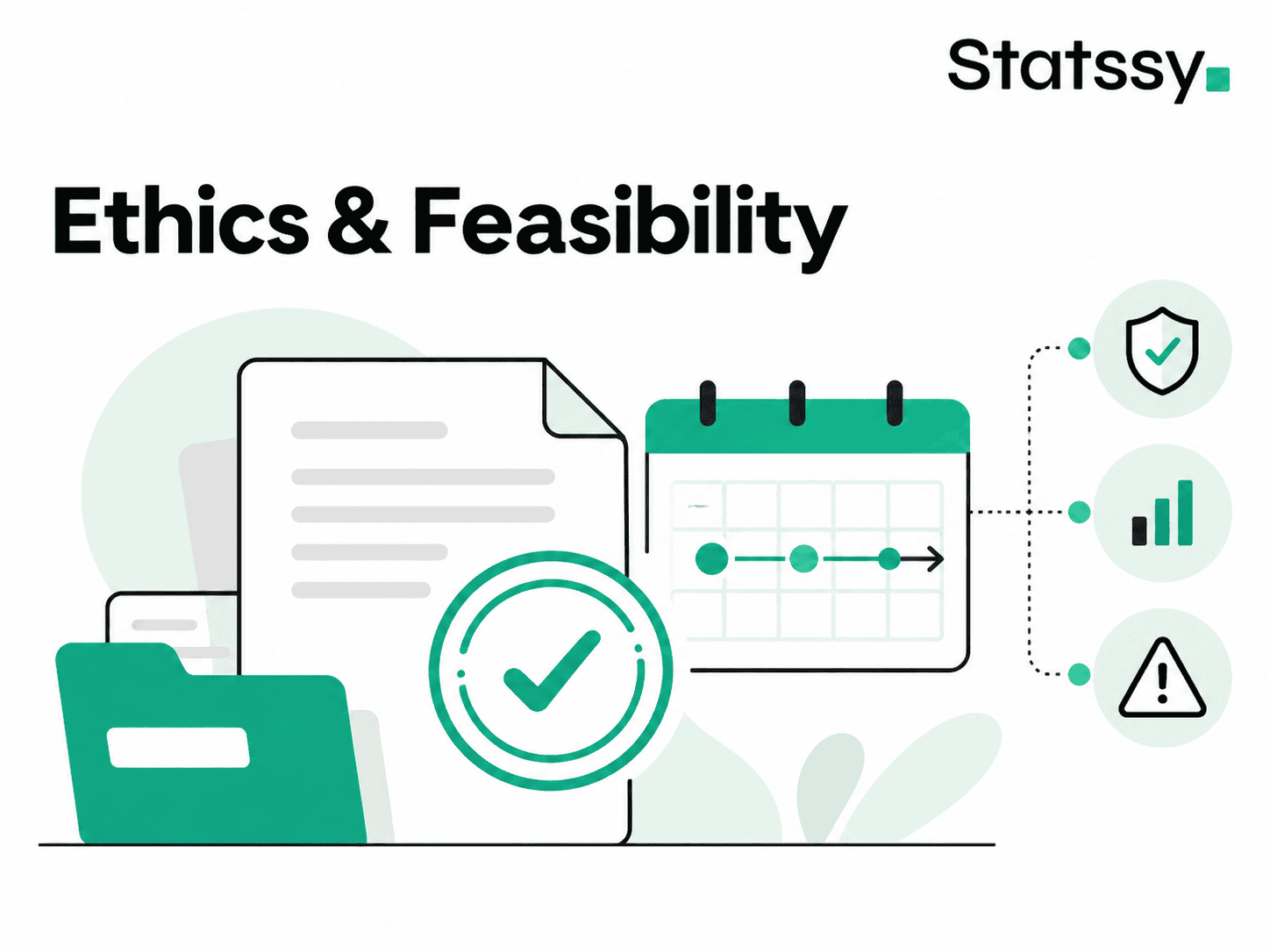
Feasibility gaps are the most common. Students write proposals that would need a sample size or access they do not realistically have, on a timeline that assumes zero setbacks. Supervisors see this immediately because they have watched dozens of students hit the same wall before.
Ethics and approval gaps come second. Students write a confident methodology section and then add one vague sentence about ethics at the end, assuming it will sail through without question. Both IRB reviewers in the US and Research Ethics Committees in the UK will send this straight back for more detail, particularly around informed consent and data storage.
Misalignment between the question, design and analysis plan is third, and it is the one students are least likely to catch themselves, because each section reads fine in isolation. This is exactly why point 9 on the checklist above exists as a separate check rather than being folded into the design section.
Dissertation Proposal Submission Requirements for the USA and the UK
Dissertation proposal submission requirements differ enough between the USA and the UK that it is worth stating the main differences plainly, especially if you are an international student unfamiliar with your university’s convention.
| Requirement | USA | UK |
|---|---|---|
| Ethics approval body | Institutional Review Board (IRB) | Research Ethics Committee (REC) |
| Common referencing style | APA | Harvard (varies by department) |
| Proposal reviewer | Dissertation committee or chair | Supervisor, sometimes with a second reader |
| Typical proposal length | 15 to 25 pages (varies by programme) | 1500 to 3000 words (varies by programme) |
These are general patterns, not universal rules, so always confirm against your own department’s handbook before you finalise formatting. When in doubt, point 12 on this dissertation proposal checklist is your reminder to check this before submission, not after.
Is a Generic Research Proposal Quality Assessment Checklist Enough
Most of what ranks online for a dissertation proposal checklist is actually written for the final dissertation submission stage, binding, formatting, library deposit forms, not the proposal stage you are at right now. A generic research proposal quality assessment checklist that only lists section headings will tell you what to include. It will not tell you whether what you wrote under each heading can survive a supervisor’s questions.
That gap is exactly why this checklist is built around the questions a reviewer actually asks, rather than a table of contents. If you have gone through all 12 points honestly and you are still unsure whether your proposal is ready, that is usually a sign the issue sits deeper than formatting, often in how your methodology and analysis plan were chosen in the first place.
None of this requires hiring anyone. Work through the 12 points honestly and most proposals get there without outside help. The one signal worth paying attention to is a repeating pattern, the same type of issue showing up across more than one draft. That usually means the gap sits deeper than a quick fix, which is a different problem from a first-time proposal needing normal revision.
If that is where you are, it is worth reading how to know if you need a dissertation expert before you submit, rather than after your supervisor sends it back. And if you are earlier in the process and want structured support through the proposal stage itself, this guide on how to find a dissertation writing mentor is a good next step.
FAQ
What is the difference between a research proposal and a dissertation proposal
A research proposal is the general term for any plan describing proposed research, used for grants, ethics applications and academic projects. A dissertation proposal is a specific type of research proposal written for a university degree, usually reviewed by a supervisor or committee before you are allowed to begin data collection.
How long should a dissertation proposal be
In the USA, dissertation proposals commonly run 15 to 25 pages, though this varies widely by programme and discipline. In the UK, proposals are often shorter, typically 1500 to 3000 words. Always confirm the exact expectation with your department handbook rather than assuming either range applies to you.
Do I need ethics approval before I submit my proposal
Most universities want your ethics considerations addressed within the proposal itself, even if formal approval from your IRB or Research Ethics Committee comes after the proposal is accepted. Check your department’s process, since some require ethics approval before proposal submission and others require it before data collection begins.
What happens if my dissertation proposal is rejected
Your supervisor or committee will usually return it with specific comments rather than an outright rejection. You revise the flagged sections and resubmit, often within two to four weeks depending on your department’s review cycle. Repeated rejections usually point to a deeper issue, often in research design or feasibility, rather than writing quality.
What is the difference between a theoretical framework and a conceptual framework
A theoretical framework is built from existing, published theory that you are applying or testing in your study. A conceptual framework is something you build yourself, often visually, to show how you believe the specific variables or concepts in your study relate to each other, sometimes drawing on more than one theory.
How many times can a supervisor send a proposal back for revision
There is usually no fixed limit, though most departments expect a proposal to be approved within two to three review rounds. If you are past that and still receiving major revisions, it is worth asking your supervisor directly what is still misaligned, rather than continuing to revise without that conversation.
What is the difference between a dissertation proposal and a thesis proposal
In most universities, these terms describe the same thing, a plan submitted before you begin independent research, and the word used usually just follows whether your institution calls the final piece of work a dissertation or a thesis. A few universities do use “thesis proposal” specifically for a shorter, taught-programme project and reserve “dissertation proposal” for doctoral work, so check your own department’s terminology rather than assuming either word signals a different process.
What is a good sample size for a dissertation proposal
There is no single number that works across every design, a quantitative study typically needs a sample size backed by a power calculation, while a qualitative study is usually justified through saturation, the point where new interviews or data stop producing new themes. What matters to reviewers is not the number itself but whether you can explain where it came from.
Written by Siddharth, independent research and dissertation consultant with 12 years of experience across R, Python, SPSS and Stata, and founder of Statssy. Connect on LinkedIn.